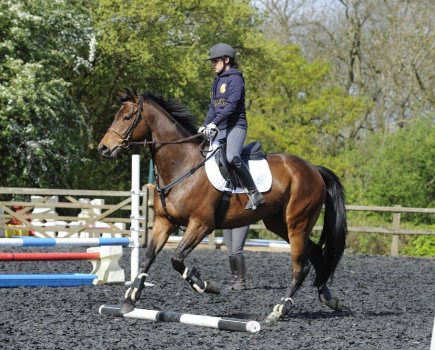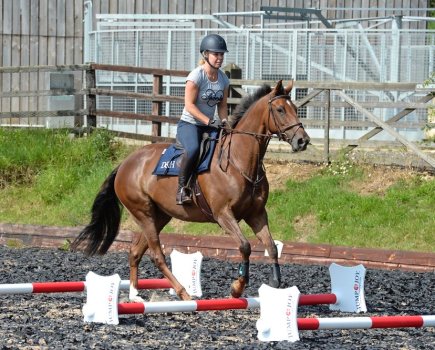


Meet our expert, Zana Cousins. She is a horse trainer and stunt rider who is well known for her unique confidence camps at The Centre of Horseback Combat in Hertfordshire. She has won medals in horseback archery and was the first female knight to perform in jousting tournaments at Warwick Castle.
A rider’s confidence to canter can dip for any number of reasons — but the good news is that this is totally normal.
As a coach, I’m passionate about helping riders to achieve their horsey dreams without fear. One way that I put this into action is through my Confident to Canter courses at my Hertfordshire base. On these courses something amazing happens: riders who arrived consumed with worry are cantering down a track, arms outstretched and with the Black Beauty theme blasting
out of our speakers the very next day.
It seems like magic, but it isn’t. My horses are meticulously trained and while my Confident to Canter courses aren’t repeatable at home, you can get creative with elements of them to top up confidence and rediscover the joys of canter.
Here are 10 things that, with a bit of effort and outside the box thinking, you can try at your own base…
Choose an incline
Possibly the simplest thing to try is to canter up hill. However, don’t start cantering at the bottom. Keep to walk or trot and only ask for canter when you’re close to the top. You only need to commit to a few strides. Canter transitions feel easier up hill and most horses will tire and naturally slow at the summit.
Make a track
Here in Hertfordshire at the Centre of Horseback Combat, we have a sand track for horseback archery that we use for our confidence courses. It takes the pressure off horse and rider and makes the space feel more enclosed.
Ask your yard owner if you can use jumps, fillers, or temporary fencing alongside an existing fence line to make a track. It doesn’t need to be super-long.
Have helpers on the ground
I station staff at the end of the canter track on courses. It gives riders confidence when they see someone who’s trained to catch the horse if needed.
I don’t recommend anyone try to catch a horse who hasn’t been trained like mine have (or indeed without having been trained themselves), but simply having helpers on the ground to support and encourage without pressure or negativity gives the rider a boost.
Break it down
On my courses, the rider’s first canter is extremely short. In fact, it’s only a few strides at the end of the track. I often
say that boredom is the opposite of fear – once you’re starting to feel like you’ve been there and done that, it’s time to harness your enthusiasm for moving up a gear and trying the next step.
My riders come down the canter track many times, picking up canter a little further away from the end with each go. By the time it comes to cantering the whole length, they’re so hungry for the next step that they can do it without fear.
Repeat, repeat, repeat
Speaking of boredom, practising over and over again is a must for confidence building. A rider’s fear of canter takes many forms: it might be the transition, it might be the distance, it might be cantering outside of the arena.
In any of these instances, using the track and building up slowly makes all of these factors totally normal because the rider is doing them again and again.
No negative talk
It’s very easy to slip into quite triggering language without giving it a second thought. Lots of riders will speculate on whether or not their horse will be “out to get them” today. Many instructors will say “prepare for canter” as if it’s something to worry about, and I’ve read many articles suggesting that canter is to be “conquered”. Why? We’re not going to war!
While it’s important to be proud of your achievements, it isn’t helpful to speak about having a canter in this way. For a well-trained horse and rider, canter is thrilling, exhilarating and, above all, fun, not something we need to arm ourselves against.
Sort your safety
Have you checked your tack? Do your feet slide in and out of your stirrups without obstruction? Are your reins or stirrup leathers looking a bit worn? Heading out safe in the knowledge that your tack is sound and everything fits as it should is as empowering as it is important.
Don’t worry about perfection
A lot of riders who come on my course are concerned about their own ability. “I can’t canter because I’m not perfectly balanced or strong. I’ve been told that I could negatively affect my horse,” they say. However, if you’re nervous about being perfect, you’ll
never do it.
The most important thing is the doing. So what if it’s not perfect? Perfection only comes with practice. Getting it wrong a few times is all a part of the journey.
Practise the worst case scenario
You can and should practise staying on by rehearsing losing stirrups and grabbing neck straps quickly and effectively. This is something you can do every time you ride. If you know that you can find a neck strap or a lost stirrup in any circumstance, confidence will follow.
Find the fun
I’ve said it before, but it’s worth repeating: I’ve never lost the 10-year-old me and I have fun every time I ride.
Think back to when you first learned to ride. Perhaps you were a small child, a teen, or maybe you learned as an adult? What motivated you to learn?
I’m willing to bet that it wasn’t to have a perfect position or out of this world balance, or to be self-critical. I’m inclined to think that you loved horses and you wanted to have fun with them. Therefore, try to carry this feeling with you when you ride. Don’t put yourself into situations that you aren’t trained for.
Keep your goals achievable and bite-sized. Surround yourself with positive people. Enjoy getting to know your horse better than ever – and have a smile on your face while you’re doing so.