
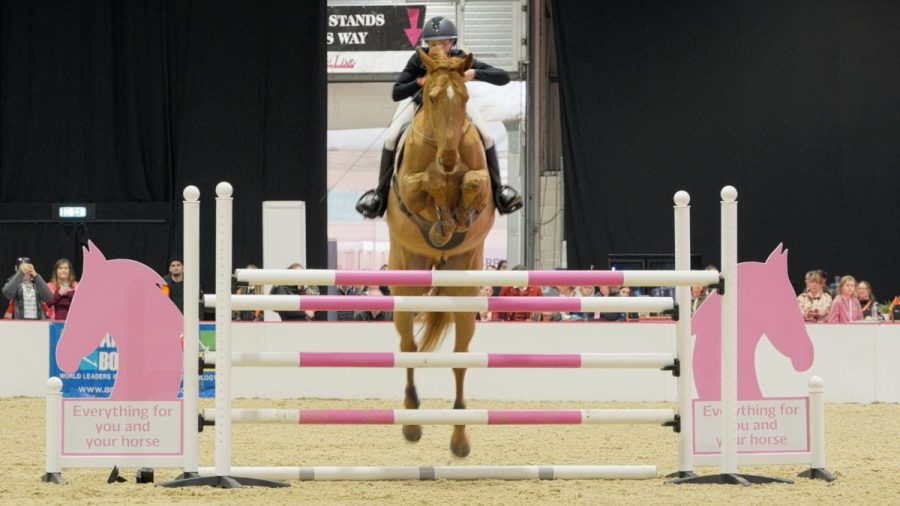
From establishing rhythm and relaxation to steering through subtle weight aids, rider, trainer and bridleless specialist Serena Kullich explained the principles behind successful bridleless riding at Your Horse Live 2026 – and how developing a deeper connection with your horse can transform your everyday training.
Having represented Great Britain at the 2023 World Young Horse Showjumping Championships, Serena has developed a training approach centred on groundwork, liberty and bridleless riding – including showjumping. Her philosophy is that riding without a bridle is the natural progression of good horsemanship, producing horses that are relaxed, responsive and connected to their riders.
“We all need our horses to be connected with us for everything that we do,” Serena explains.
Here are her essential training principles.
1. Establish rhythm and relaxation
Before considering removing the bridle, your horse must be able to maintain a consistent rhythm without relying on the reins.
“The very first thing when I’m teaching my horse bridleless is to make sure I have both rhythm and relaxation in all paces,” says Serena.
This means being able to trot and canter without continually using the reins to regulate the speed.
If the horse begins rushing, Serena recommends using inside flexion and the inside leg to rebalance before softening the reins again.
Repeat the exercise until the horse learns to maintain the desired pace independently.
“It’s teaching our horses that it’s their responsibility to maintain the rhythm that we set, not ours to keep making little adjustments,” she explains.
2. Teach your horse to follow your weight
The next stage is developing steering and stopping aids through the rider’s body.
“To turn, I look the way I want to go, turn my shoulders,” Serena explains.
When turning left, for example, the rider’s weight shifts slightly left, while the outside leg can move back to reinforce the direction.
To stop, Serena thinks about allowing her weight to sink down through her seat and stirrups, while ceasing to follow the horse’s movement.
“It might not look obvious to you, sat in the audience, but your horse can really feel that,” she says.
If the horse doesn’t understand, briefly pick up the reins to clarify the aid, then soften them again.
3. Introduce a neck rope
Once the horse reliably understands weight aids, a neck rope can provide an additional means of communication.
Pressure against the side of the neck reinforces turning, while a gentle signal towards the chest can support the stopping aid.
However, Serena emphasises that the ultimate aim is for the horse to respond primarily to the rider’s seat.
“For me, the aids when riding bridleless should come from our seats,” she says.
Practise these exercises with a bridle and reins in place until the horse consistently responds without needing rein corrections.
4. Develop collection through your seat
Collection is another important element of bridleless riding.
Serena demonstrated how sitting taller, shifting her weight slightly back and engaging her core encourages her horse to shorten and collect his canter.
When she allows her seat to follow more freely, the horse moves forwards again.
The objective is to develop a horse that understands subtle changes in balance rather than relying on rein pressure.
5. Don’t rush to remove the bridle
Bridleless riding should be the result of progressive training, not the starting point.
Serena advised practising steering and stopping repeatedly while retaining the reins as a backup.
Only when these aids are thoroughly established should riders consider progressing further, ideally with experienced supervision in a secure, enclosed arena.
Serena Kullich’s top tips for bridleless riding
- Prioritise relaxation: establish a calm, consistent rhythm in every pace.
- Use your seat: practise steering and stopping through subtle weight changes.
- Reinforce, then release: use the reins to clarify an aid before softening again.
- Introduce the neck rope gradually: it should complement, not replace, established aids.
- Take your time: never remove the bridle until your horse responds reliably and you have appropriate professional support.
You might also enjoy…
- These are the core principles of natural horsemanship
- What we learnt about riding accurate cross-country lines from Simon Grieve at Your Horse Live
- Stars shine and great stories shared among winners at 2026 SEIB Search for a Star Championships
- Nine-year-old jockey and 19-year-old pony steal the show to land Search for a Star overall supreme title
- Meet Oliver Townend & Ballaghmor Class at Your Horse Live
- Ros Canter & Becky Moody together for the first time ever at Your Horse Live!