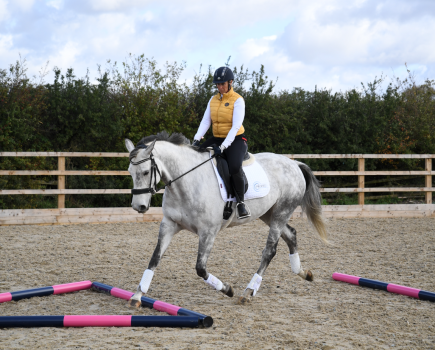

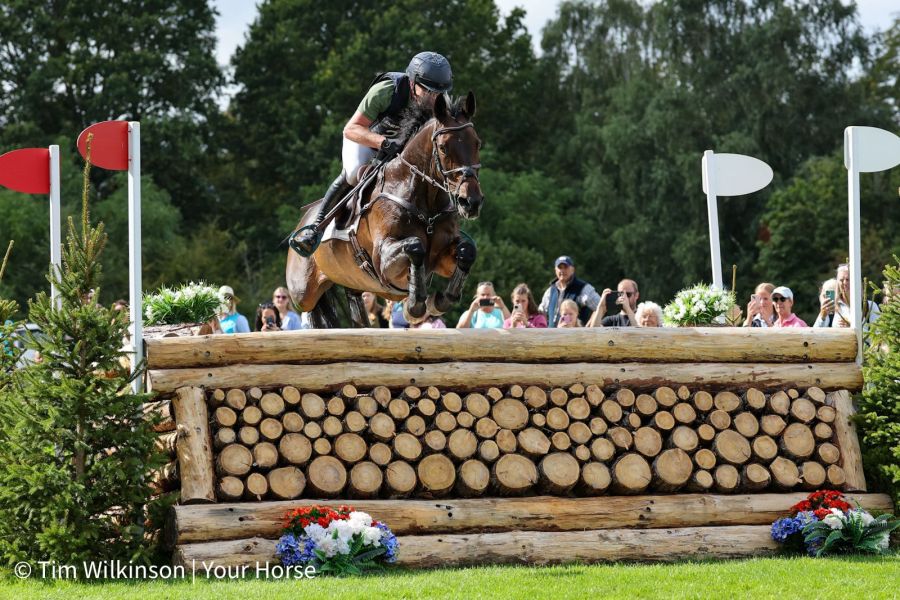
Five-star event rider, coach and social media personality Simon Grieve (pictured top jumping clear across country at Burghley in 2026) explains how straightness, adjustability and a positive approach can transform your cross-country performance, with practical exercises to try at home.
Accuracy is one of the most important ingredients of successful cross-country riding.
During a training demonstration at Your Horse Live 2026, with two very different horses and riders – equestrian influencer Megan Elphick and a five-year-old that she had only ridden once before and farrier and amateur rider Sam Dracott aboard his all-rounder – five-star event rider Simon Grieve showed how simple flatwork exercises, a quality canter and confident riding can make technical cross-country questions feel straightforward.
“Accuracy is a really important element,” Simon explained. “And that starts with the true basics.”
Here are his key takeaway points from the session.
1. Straightness starts with good flatwork
Before tackling any fences, Simon asked both riders to concentrate on straight lines, balanced corners and establishing a connection between leg and hand.
“We want to be focusing right now on riding nice straight lines, riding good corners, and making sure we’ve got horses between hand and leg,” he said.
Controlling the shoulders through the turn is particularly important. If the horse falls out through its outside shoulder, the rider will struggle to establish a straight approach to a narrow fence.
2. Think forward, not backwards
One of Simon’s strongest messages was that accuracy should never come at the expense of impulsion.
“Quite often, when we’re trying to be accurate, we end up riding a little bit backwards,” he explained. “Straightness comes from being forward and being positive.”
Rather than using the hand to manufacture straightness, riders should create a channel between their legs and reins, encouraging the horse to travel confidently towards the fence.
For horses that become tense, Simon suggested introducing leg-yield and gentle changes of pace.
“We want the leg to be the horse’s friend,” he said, emphasising that horses should learn to accept the rider’s aids without becoming anxious.
3. Develop gears within the canter
Throughout the session, Simon encouraged both riders to experiment with the pace, moving the canter forwards and backwards while maintaining rhythm.
“Play with the gears a little bit,” he advised.
Riders practised opening the canter down the long side before sitting taller to rebalance, simulating the adjustments needed between galloping fences and more technical combinations.
The aim is to have a horse that responds immediately when asked, without becoming hurried or losing energy.
Simon reinforced this as homework: “You’ve got loads of gears you can play with, and when you put them on, you want to get a response.”
4. Look where you want to go
When introducing narrow fences and angled lines, Simon encouraged riders to focus on a point beyond the obstacle.
“Find a point beyond that,” he instructed. “Focus on the straightness.”
He also reminded riders that a jump involves the approach, take-off, flight, landing and getaway.
Straightness must be maintained throughout, rather than just concentrating on getting over the fence.
“Keep your eyes up and where you’re going,” he added.
5. Make technical questions simple
To introduce corners, Simon initially removed the back rail, allowing the horses to understand the exercise before increasing the difficulty.
When the complete corner was introduced, he encouraged riders to imagine a straight rail running through its centre and approach squarely to that line.
“I always think performance and repetition is the best thing,” he explained, encouraging riders to repeat exercises until they became easy and relaxed.
6. Trust yourself and maintain the flow
One of Simon’s most important lessons was about rider confidence.
He noticed that hesitation could cause riders to hold on to the reins, disrupting the canter and making technical fences unnecessarily difficult.
“Trust yourself a little bit more,” he encouraged. “Believe in flow.”
Ultimately, Simon’s philosophy was refreshingly straightforward.
“You put in a rhythmical canter and you steer, and the horse does the job,” he said. “It is that simple. But we make it all up in our heads.”
You might also enjoy…
- Stars shine and great stories shared among winners at 2026 SEIB Search for a Star Championships
- Nine-year-old jockey and 19-year-old pony steal the show to land Search for a Star overall supreme title
- SEIB Search for a Star Showing Championships
- Meet Oliver Townend & Ballaghmor Class at Your Horse Live
- Ros Canter & Becky Moody together for the first time ever at Your Horse Live!
- Harlow takes over Your Horse Live for one night only!