

For some Thoroughbreds, the ultimate glory is sprinting down the home stretch on Ascot’s hallowed turf. For others, it’s charging down Cheltenham’s challenging 4’6” fences or clearing Aintree’s infamous Becher’s Brook.
Once their racing days are over, they can go on to any number of new careers, from dressage to polo, eventing to endurance — but when it comes to retraining them, are there any differences between former Flat and former National Hunt (NH) racehorses, asks Catherine Welton?
Jess Westwood runs Molland Ridge Stud and Rehabilitation and is a trustee of The Thoroughbred Breeders’ Association. She’s retrained around 400 horses and says that when Flat and NH horses first come out of racing, they tend to have different physiques.
“The Flat horses are generally smaller and their muscle group is a lot bigger. Think of them as your Usain Bolts, whereas your National Hunt horses are more like Mo Farah,” she explains.
Muscling up
Whether you have a sprinter or an endurance athlete, both equine physiques are specific to racing and require transforming for a career outside it.
“They’ve all got a muscle group that encourages flat, long strides, but to do a different career requires the Thoroughbred to balance in a different way and slow down,” adds Jess.
“Retraining starts when you’re able to develop muscles they haven’t engaged before. This can be challenging in a fit racehorse when ideally you would let down their fit muscle groups first.”
Pam Atkinson, co-founder of New Beginnings, where racehorses have been retrained since 2010, agrees.
“It can take months for them to become a horse that used to race,” she says. “Then they need to rebuild their muscles to be able to carry additional weight, compared to a jockey and
a racing saddle.”
The size of the matter
Flat racers tend to start younger and retire earlier, whereas jump horses can continue racing into their teens. Jockey weights differ too, with Flat horses carrying a maximum of 64.4kg and NH horses carrying up to 76.2kg. This is something that Amanda Mills, who runs Mills Stables Retraining Racehorses, considers when matching an ex-racehorse to a new owner.
“Smaller and/or lighter riders will be more suited to most of the young Flat horses, because Flat horses often retire needing more time to mature and have always been ridden by small, light jockeys. It can take a lot of time until they are physically ready to carry an inexperienced rider,” says Amanda, who has retrained and rehomed hundreds of off-the-track-Thoroughbreds over the years.
“Jump horses, usually being more physically mature when they retire, will still have the same issues with inexperienced riders retraining them, but their bodies are a bit more capable of withstanding the new style of riding.”
A horse-first approach
That said, Amanda doesn’t let the horse’s racing career dictate what they might be capable of going forwards. Instead, she takes a horse-first approach.
“We start them all the same and sometimes I don’t look at their racing records so that I don’t judge them on what they have done,” she says. “I prefer to leave it down to them to let me know what they want to do.
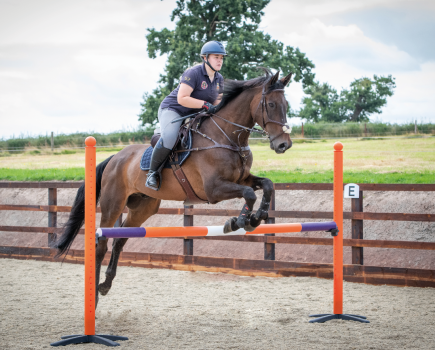
“We have some jump horses who never want to jump again and some Flat horses who love it,” she continues. “Some of the best jumpers we’ve produced have been horses that only raced on the Flat.”
Perhaps surprisingly, teaching a former Flat racer to jump can be easier than teaching an ex-hurdler, because they’re not having to “unlearn” a previous
way of going.
“When they’re racing, they tend to jump a lot lower and flatter and off a long, galloping stride, so when it comes to retraining, we have to reteach these horses how to jump if we are wanting to produce them for showjumping and eventing,” adds Amanda.
Keep an open mind
Either way, patient, consistent training is key, as Jess is keen to emphasise.
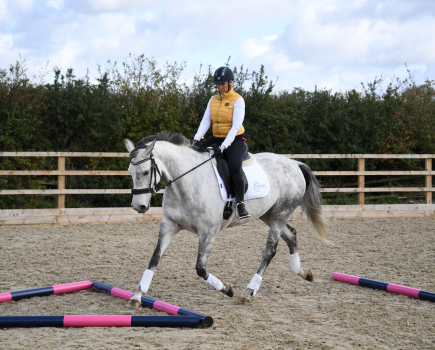
“The biggest issue in retraining is people not giving the horses enough time to change their bodies,” she says. “Until they can sit on their hocks and canter, they can’t learn to showjump and go cross-country.”
Jess advises giving the horse at least a year before jumping competitively.
“Go to some local dressage competitions, which are a perfect way to teach a horse to behave in a relaxed environment. Then the following year, you’ll have a different horse. As soon as they’ve built up the correct muscles, they can all jump.”
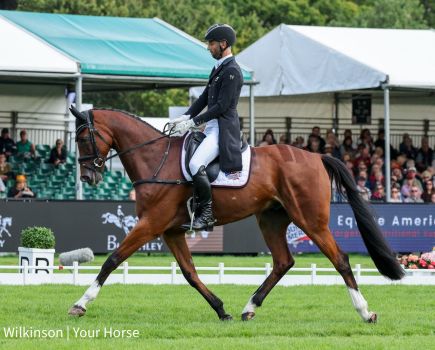
And don’t discount a former jump horse as your next dressage superstar either, says Amy Bannister-Bell, a BHSI and a Regional Development Officer for the Retraining of Racehorses (RoR).
“It is a common misconception that racehorses do not receive any education on the flat. Many yards are utilising and seeing the benefits of flatwork as part of the training regime for their National Hunt horses,” she explains. “It is important to keep an open mind to the potential second careers of these horses as they are good at demonstrating what they will be good at given a chance. And they can often surprise you.”
Seeing the world
Although all horses should be treated as individuals (see below), there can be differences in how much of the world Flat and NH racehorses see, which comes back to their maturity.
“The Flat racers start careers younger and tend to come to us younger, so sometimes they’ve had a bit less exposure,” explains Pam.
But she also points out that where they’ve been in training can have an equal impact on how worldly they are: “Some horses in training go out hacking through the village, but if a trainer has their own gallops, they might not have seen as much. That said, they still go to the races, where there’s a lot to see.”
Lucinda Sims is an accredited instructor with the RoR and she agrees.
“Many horses from big training centres are excellent in traffic, but those trained in quiet areas rarely see traffic, so it’s best to introduce it quietly and sensibly.”
Nonetheless, she points out that all racehorses have generally seen more of the world than an ‘ordinary’, privately-owned young horse. Lucinda currently has 12 RoRs in her care and holds regular clinics and open days to promote and champion the breed.
“Most Thoroughbreds have better natural manners and temperaments than your average warmblood or cob. I find them to be sensitive, empathetic, clever and brave — I don’t really want anything else on my yard.”
No two horses are the same
While researching a former racehorse’s background can provide helpful information, trainers agree it’s best to consider each horse on their own merits.
As Amy says: “I’m yet to find two Thoroughbreds that are the same, even when they have had similar early life experiences.”
And whatever the horse’s background, Pam adds: “If you’re getting a racehorse for the first time, get it from somewhere that gives you a full understanding of the horse and provides continuing support, and surround yourself with knowledgeable people to help you.”
Train the horse in front of you
Lou Robson has been riding former racehorses since she was 15 and competes them at all levels of dressage. For the past 15 years, she has run Thoroughbred Dressage and is dedicated to retraining racehorses with a dressage focus.
“I have known of jumpers who’ve fallen out of love with jumping and made fantastic dressage horses,” she says.
When it comes to temperament, she advises treating them as individuals.
“I’ve seen some horses leave racing fit and fresh. Then once they start their retraining, they are relaxed and Zen-like. Some just want to be happy hackers. The main thing is that we train the horse we have in front of us, love them for who they are, listen to them as to what they love and enjoy, and pursue that in their retraining journey.”
Image credit: Shutterstock
Related content
- Is an ex-racehorse the right choice for you? We investigate…
- Thinking about buying an ex-racehorse? Here’s what you need to know abut where you can purchase one
- Top tips for introducing hacking to an ex-racehorse
- How to feed and retrain the gut of an ex-racehorse
- New eventing initiatives for former racehorses
- Ex-racehorses shouldn’t carry more than 17% of their bodyweight, says RoR