
Sponsored content in collaboration with Dengie
When a horse’s workload increases, it is natural to assume that their diet must change to something that provides more energy. However, before reaching for a higher‑energy feed, it is worth asking two important questions: how hard is your horse really working, and how is their bodyweight on their current diet?
It is common for us for us to overestimate how much work our horses are doing. This can easily lead to excess calorie intake, unwanted weight gain, and associated health risks with being fat. Understanding workload, monitoring body condition, and knowing when dietary changes are required is key to helping maintain your horse at a healthy weight.
How hard are they really working?
Feed companies often provide a description to help owners assess their horse’s workload as shown in the table below, but these are only guidelines and should always be considered alongside your horse’s weight.
| Workload | Description of workload |
| Maintenance | Horses at rest or those that are not taking part in any ridden or enforced exercise, such as those that are retired. |
| Light work | Generally, this includes light hacking and schooling, mostly at walk and trot with some canter. Local, unaffiliated competitions are probably only light work for most horses and ponies. |
| Medium work | Usually includes regular schooling for around an hour a day and competing in affiliated competitions. |
| Hard work | These horses will be competing at higher levels and their training and schooling reflects this. Eventers and racehorses will do more faster work in their training, whereas dressage horses work harder to do more advanced movements. Showjumpers often compete frequently and the rigours of travel may also increase the horse’s energy and nutrient requirements. |
Reliable indicators
One of the most reliable indicators of whether your horse’s energy intake is appropriate for their workload is their level of fat cover. If too much energy is provided for the work done, excess weight gain is likely.
If too little energy is provided, your horse may begin to lose weight or struggle to maintain condition.
Regular monitoring is essential. Using a weigh tape every couple of weeks, combined with monthly body condition or fat scoring, can help you spot changes in weight early so that you can make dietary adjustments sooner rather than later to maintain them at a healthy weight.
Increasing the bucket feed
A common question is when it is necessary to change a horse’s bucket feed if their workload increases.
When it comes to energy, it is best to increase workload first, then observe how your horse responds before changing their feed.
If your horse’s workload increases but they remain overweight — or continue to hold weight easily over time — this suggests they are receiving more than enough energy for the work they are doing.
In this situation, switching to a higher‑energy feed is unnecessary until your horse has lost weight and starts to become lean. Instead, focus on improving fitness gradually and ensure the diet remains balanced, as the requirement for nutrients like protein, vitamin E and electrolytes increase with increasing workload.
Trace minerals
Whilst your horse may not need an increase in energy intake, them may need a higher specification product to meet their needs.
Whilst working good doers can often easily maintain their weight on a ration of grass and conserved forage, UK pasture and conserved forage commonly lack the trace minerals copper, selenium, and zinc.
Vitamin E is also particularly lacking in conserved forage, as is quality protein, particularly if more straw is used in the diet, and as such we look to add these nutrients to the diets of all horses on a forage-only diet.
Nutrient deficiency
For weight loss we want an energy deficit, but not a nutrient deficit. Situations where a horse on a weight management regime is likely to have a greater degree of nutrient deficiency that will need addressing include:
- When the horse has restricted or no access to grass.
- When the horse is being fed soaked hay and/or a greater proportion of straw.
- When the horse is having less than the recommended quantity of a feed with added vitamins and minerals. Your horse will only get a balanced diet if they are fed the recommended quantity of a feed fortified with vitamins and minerals.
- When a horse in moderate work is having a fortified feed designed for horses at rest or in light work in a bid to manage energy intake.
If your horse can’t have the recommended amount of a feed fortified with vitamins and minerals to balance their diet because it provides too many calories, a feed balancer or broad-spectrum vitamin and mineral supplement can be used as an alternative.
Feeding a balancer
A balancer is a highly concentrated feed that supplies a broad-spectrum of vitamins and minerals as well as quality protein for a balanced diet.
Typically, a balancer is in the form of a pellet and fed at 100g per 100kg of bodyweight daily, and because the feeding rate is low, so is the amount of energy supplied.
This makes balancers ideal for horses that hold their weight with ease, particularly when compared to the recommended amount of a traditional mix or cube — even low energy ones.
One point to note is that compared to a balancer, a broad-spectrum vitamin and mineral powder supplement is less likely to supply significant levels of quality protein.
This isn’t necessarily an issue if other components of the diet are supplying sufficient quality, however, if the rest of the ration is limited in quality protein, which may be due to limited grazing or an increased amount of straw in the diet, then a feed balancer will help to counteract the shortfalls.
Low-calorie fibre
Whether it is a balancer or broad-spectrum vitamin and mineral supplement that you choose, add it alongside a low-calorie fibre feed to slow the rate of eating or act as a carrier for the powder supplement.
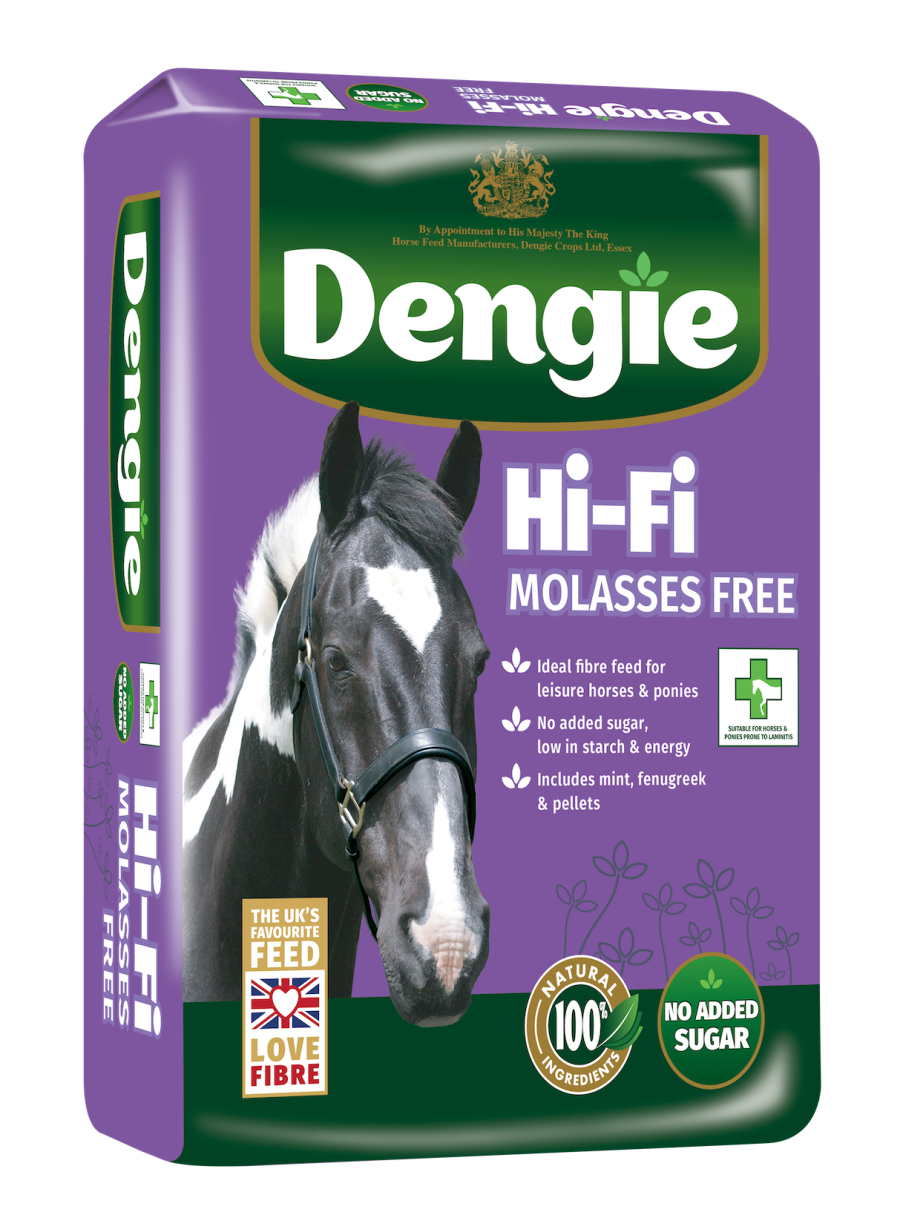
Dengie Hi-Fi Molasses Free is the ideal base to the ration for the working good doer, as it combines chopped and pelleted alfalfa and straw with a light rapeseed oil coating, mint, and fenugreek.
Hi-Fi Molasses Free is a low-calorie fibre feed at 8.5MJ/kg digestible energy. At only 2.5% sugar and 1.5% starch, it is also one of Dengie’s lowest sugar and starch feeds combined, making it very appropriate for horses and ponies that may also be prone to laminitis and are in work.
What if my horse is lazy?
Energy, which is often associated with enthusiasm for work, and calories, which are often used to describe a horse’s weight, are the same thing.
If your horse is lacking enthusiasm to work and is overweight, then they are already receiving more energy than they need. Increasing their energy intake will only result in further unwanted weight gain, rather than an increased enthusiasm for work.
Ultimately, an improvement in energy levels is only likely to be achieved by achieving a healthy weight combined with improved fitness.
If lethargy is out of character for your horse, it is also essential to establish if there is an underlying cause to the problem, such as ill health or pain and discomfort from ill-fitting tack.
Hydration
Hydration is also important to maintain energy levels. Salt, or more specifically sodium and chloride, are just two electrolytes that are required by the horse, alongside lesser amounts of potassium, calcium and magnesium.
All feeds and forages will provide some electrolytes, but even for horses at rest sodium is often lacking and so should be supplemented.
For horses at rest or in light work, table salt can be added to their feed to supply sodium and chloride, but for those in regular sweaty work, a commercial electrolyte supplement should also be fed at the manufacturer’s recommendations to maintain hydration.
Free access to water should always be offered alongside.
For advice about your own horse’s workload and feeding requirements, contact Dengie
Main image © Your Horse Library