
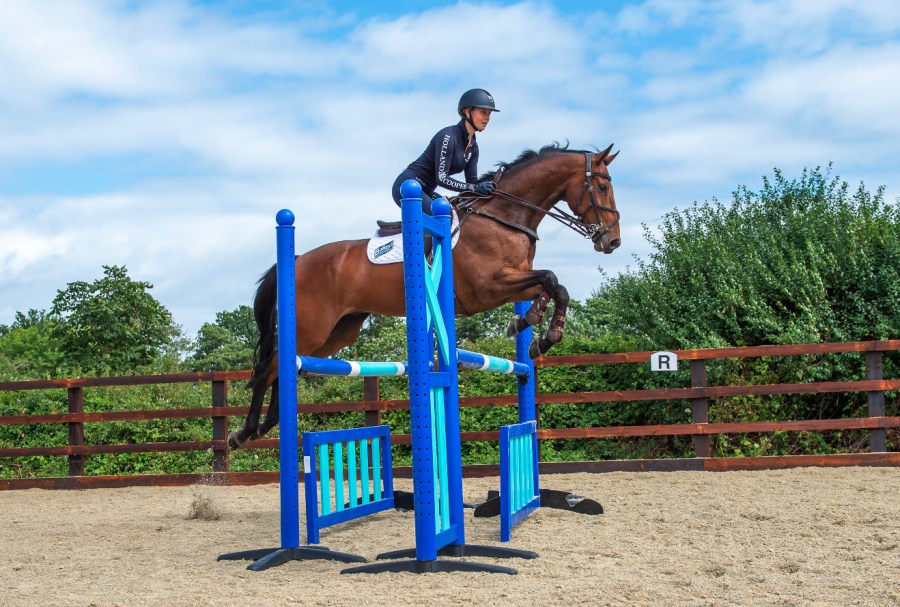
Whether you’re training or at a competition, walk any showjumping course and you will come across a range of different style of fences. From cross-poles to upright fences and oxer jumps, they are all designed to ask different things of your horse.
Here is a selection of some of the fences you will see and what the course-designer hopes to achieve by placing them there:
True oxers
These are made up of two vertical rails parallel to each other (ie at the same height). You may hear these described as being “square”.
Oxer jumps are great for building strength behind and will encourage your horse to really stretch up and over the front and back rails.
Because of the power your horse uses to push up and over, they may run on a little on landing, or lack energy because they used it up in the air.
Ascending oxers
Like true oxers, an ascending oxer is built with two vertical rails parallel to one another. However, in an ascending oxer the back pole is set slightly higher than the front, which will encourage your horse to jump in the correct shape.
Particularly at the lower levels, these make inviting first fences on a course and the front pole may be replaced with a cross-pole instead.
Swedish oxers
Swedish oxers, where the front and back poles slant in opposite directions, are especially useful. The centre point, created by the V shape where the poles cross, will help with straightness and tells the rider exactly where the centre of the fence is (this is where you should be aiming to jump!).
A Swedish oxer is also good for encouraging good lift and tuck of the horse’s front legs.
Liverpool oxer
This is a vertical or oxer with a ditch or water tray underneath. The tray makes the horse look at the fence as they approach, which can cause their head and neck to drop, and then encourages them to get up in the air, creating a large, round jump.
Place the tray in front of the fence and it mimics the effect of a triple bar, encouraging a wider, more open jump which rises gradually. Place the tray under the fence or out behind it and your horse will draw deep into the fence, producing a more upright take-off and more reach as they land.
If you don’t have a water tray to practice with at home, you can create the same effect by laying something on the ground beneath a fence, such as a rug.
Triple bar
Made with three poles of ascending height, triple bars create a longer, more open jump. Your horse really has to stretch and lift their front end to clear them, and they can be challenging when linked with other fences.
Because their width requires more power, your horse will come deeper into the fence before take-off and land further out than normal, so if you’re working out your strides to the next fence keep this in mind.
Uprights
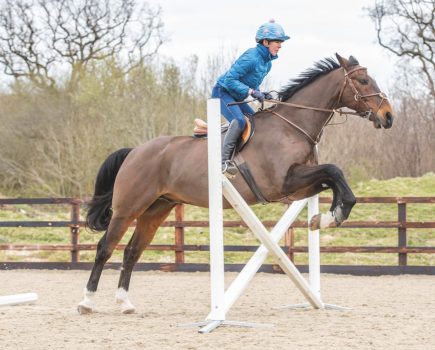
An upright fence (also sometimes called a vertical) requires your horse to jump height rather than width. To clear it, your horse must roll back onto their hindquarters in order to push themselves up and over the fence. It’s great for building strength and working on accuracy of take-off.
A vertical (or upright) is made of poles in the same vertical plane, and encourages your horse to make a taller, rounder shape in their jump.
The take-off and landing spots will be the same distance away from the fence, so your horse will make a steep shape into it, lifting the shoulders higher vertically and tucking their forelegs up and away quickly.
Planks
Possibly the king of uprights! Planks work in the same way as a vertical, creating a tall, steep jump shape. However, they’re potentially easier to knock down with even the slightest of touches as they sit on flat cups.
Planks create a more solid-looking fence, so your horse may back off a bit and produce a bigger jump. As they tend not to have a ground line, they’ll draw the horse in deep, meaning a more powerful jump is needed to clear them.
This type of fence tends to come in quirky, brightly coloured patterns, too!
Fillers
Great for adding a bit of colour and interest to a course — and more often rider frighteners than a problem for the horse!
Fillers are great for getting a round shape in your horse’s jump, and by creating an illusion of solid colour they’ll really look at what they’re approaching.
Fillers are great for a bold horse because they demand respect, but if they’re lacking in confidence, fillers can make a fence trickier to ride.
Cross-poles
Cross-poles create a V shape at the centre point, which becomes narrower as the height of the jump increases. They encourage your horse to lift the front legs, keeping them neatly tucked up and in as they jump.
Many people choose to begin with a cross-pole in the warm-up, sometimes jumping from trot — especially on younger/inexperienced horses.
The taller the cross-pole the more it will improve a horse’s action, as they have to really use their shoulders and lift up.
Raised trotting poles
Popular in training and for good reason, raised trotting poles make your horse work hard, keep them interested in their work, and help them concentrate.
Raised poles can be physically demanding, so you don’t need to work over them for too long.
Ground poles
Popular in training, a ground pole can really boost your horse’s bascule when used to create a wider fence base. The horse will instinctively know what to do.
Without a ground line a fence becomes more advanced, drawing your horse in close, making it harder for them to jump well and get their legs out of the way in time.
You can also make a V-shape with ground poles before fences to channel your horse’s energy on approach, helping produce a better jump.
Main image © Your Horse Library