
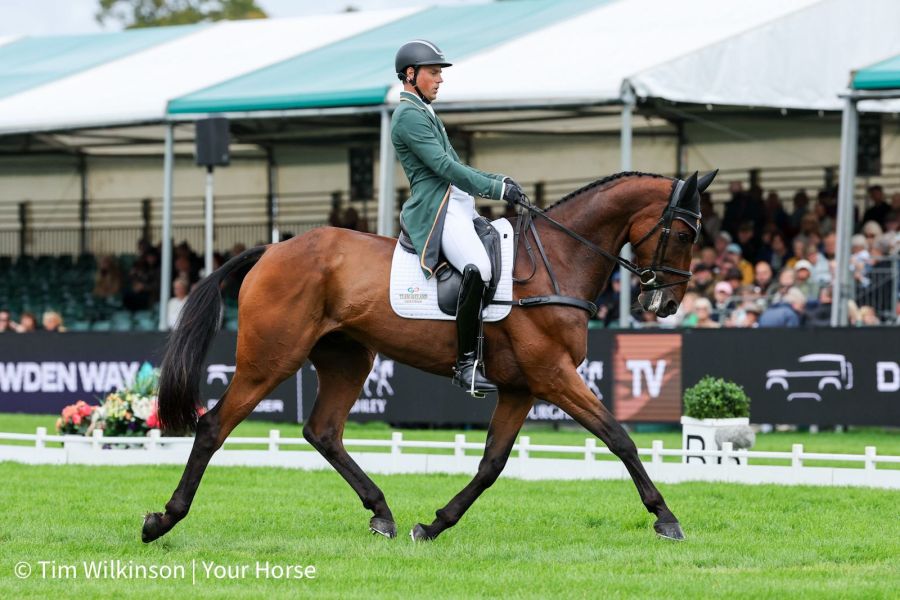
Anyone who has ever ridden a horse with seemingly endless amounts of energy will know that channelling it into something useful is a balancing act. You want to harness their enthusiasm without it tipping into tension or becoming difficult to control — especially in the dressage arena.
For Ireland’s Sam Watson, building trust has been key to keeping his exuberant Defender Burghley ride, Ballyneety Rocketman, focused in a big atmosphere.
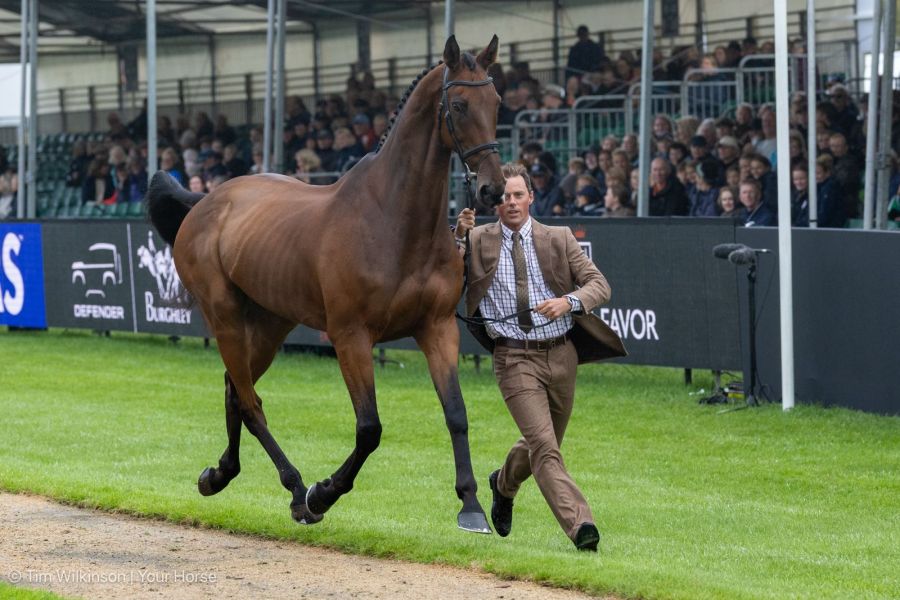
The 12-year-old gelding really lit up at Wednesday’s first horse inspection, snorting, on his toes and looking at the crowds. Sam wondered whether he might struggle to contain the horse once they entered the main arena for their dressage test.
“This is his fourth five-star, so he’s done Burghley before, he’s done two Badmintons, and I did worry that after the trot-up, because he hasn’t exploded quite that much before, that they get to know where they are,” said Sam.
‘They can’t ever be afraid’
He has been riding Rocketman since he was four and explained that the key to managing all that energy is trust.
“It is about trust,” he said. “I think it’s the same with teaching humans in school. Of course you’ve got to have a bit of discipline, but they can’t ever be afraid. You’ve got to be the teacher that they want to go to.
“You’ve got to become the teacher that if they have a problem and they’re feeling anxious and nervous, you’re their security blanket. You’re the teacher they can trust.
“Of course you’ve still got to train them, and you’ve got to say, ‘Hey, mate, you made a mistake there, let’s go back and do it again’, but you’ve got to discipline with kindness and with empathy.
“It’s high performance, and you’ve got to look for high standards, but you do that through repetition. The horse does not ever get anything to be anxious [about] from me, and over the years you hope that that helps him go, ‘Okay, teacher knows best. Whatever you’re asking, I’ll try my best.'”
Confidence from consistency
Sam said Rocketman settled and started their test nicely today (4 September), although he was disappointed to make a costly mistake in the second-to-last flying change.
“The trot work was the best it’s been for sure, so that’s going the right way,” he said. “The second-to-last change was an absolute car crash.
“It was a shame to put something that big an error into a test. You know, at this level, the rider shouldn’t be letting that happen, but you’ve got to take the progress in terms of looking forward.”
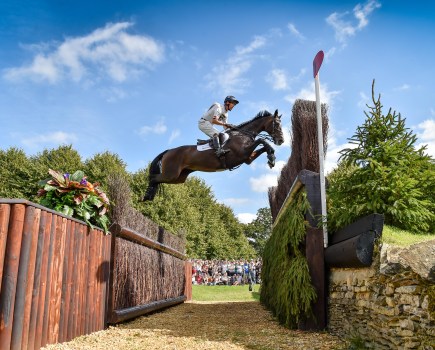
Looking ahead to tomorrow’s cross-country, Sam said that if his horse’s attention is drawn away from him, controlling his power and pace could become difficult.
“Sometimes he can go, ‘Oh wow, there’s crowds, there’s whatever’, and if his attention leaves me, it is difficult because he has so much pace,” he explained.
“I don’t think there’s a horse in here who would match him over a furlong going up a gallop. When he gets open and when he gets long, for him to get back is difficult.
“What does help is the ground, because the slower horses want to bounce off firm ground. They don’t want any energy loss; they want to skid across the top of it because that’s their most efficient way.
“He’s the opposite. He’s got so much speed, so much power, he needs that cut [in the ground] to slow down, so the conditions are right for him.”
The four ‘S’ responsibilities
Once out of the start box, Sam’s focus will be on keeping that partnership together.
“All my focus is on what he is thinking, it’s not about me at all and it’s certainly not about the scoreboard,” he said. “You just focus on, is he relaxed? Have I got his right shoulder? Does he feel even in both reins? Is he listening to me? What can I do to help that?
“I have four responsibilities: control the speed, the straightness, the softness, and stay on my 4 S’s. If I can do that, normally it goes pretty well. Keeping the speed right and keeping the straightness — that’s all I’m thinking about.”
Images by Tim Wilkinson
Related content
- ‘Chronic bucker’ once ‘facing a bullet’ takes on Burghley with Aussie first timer
- 15 years later: Kiwi rider returns to Burghley with ex-racehorse and Melman the giraffe mascot
- From failed sale to Burghley: Caroline Pamukcu makes her debut on unlikely five-star horse
- How to watch this week’s Defender Burghley