
Horse sport’s social value in the UK has been quantified for the first time thanks to new research from British Equestrian. While those who ride or care for a horse understand the enormous benefits our animals can provide, the figures provide measurable evidence of the sector’s role as a national wellbeing resource.
The governing body’s project has calculated the sector as a whole delivers £1.2 billion of social value annually and in addition, each riding centre provides an average of £292,000 worth of value per year.
According to the government, social or public value is “all significant costs and benefits that affect the welfare and wellbeing of the population”, and includes both the direct benefit and value to individuals of improved wellbeing and the wider value to society, including the state.
The British Equestrian research project began last year when a research team from Sheffield Hallam University and the Sport and Recreation Alliance searched academic databases and gathered evidence. Much of this evidence focused on equine-assisted therapy and its transformative effects on participants.
The review identified evidence of equestrianism’s positive contributions across physical and mental health, subjective wellbeing, individual development, and social and community development. It showed that horse sport’s impact reaches far beyond individual participation, generating significant savings to public services and making a vital contribution to national wellbeing.
The second stage of the project, began in May 2025, when British Equestrian partnered with State of Life to draw on stage one findings, as well as sector-level and national data, to calculate a monetary figure on equestrian social value and show that such activity can be a vital contributor to public health. The research measured both on and off-horse activity, as well as volunteering.
The total annual social value of equestrian activity in the UK was found to be £1.2 billion, and a quarter of this is generated by riding schools, with an average social value of £292,000 per school.
On-horse participation was valued at £2,000 per year for an adult riding twice monthly and £3,500 per year for a young person riding weekly. Off-horse participation came out as £2,000 per person, per year, while volunteering at £2,100 per year for weekly activity and £1,000 per year for monthly participation.
Transforming lives
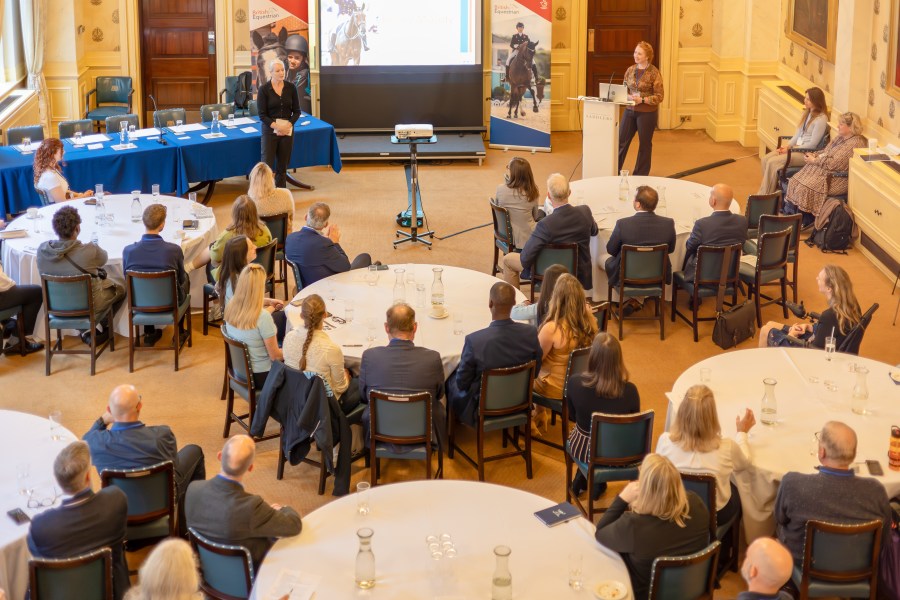
Olympic dressage rider Becky Moody spoke at a launch event for the British Equestrian findings, which was attended by representatives from across the sector, government officials and stakeholders earlier this month.
Becky explained how in times of stress or anxiety, notably when she found out she was to make her senior championship debut at the Paris 2024 Olympic Games, time with her horses give her a safe space.
Panel member Jehmar Jonas shared how Ebony Horse Club in London and Power of Polo helped him through challenging experiences as a young boy growing up and losing his brother to knife crime. Jehmar is now a youth worker and witnesses the special interactions even those most troubled can have with horses.
“I feel like, in my journey of healing from a lot of the things that I’ve witnessed and a lot of the things I’ve experienced, if it wasn’t for those touchpoints of horses and places like Power of Polo and Ebony Horse Club, I wouldn’t be sitting here,” he said.
Khianna Lucas-Young spoke of how, after battling leukaemia and other health conditions that left her paralysed and blind, she now rides with the Riding for the Disabled Association (RDA) and is grateful for the incredible volunteers who help her every time she rides.
“It’s just a safe haven and it definitely did save me,” she said. “Mentally, physically, in every way, shape or form, I owe everything to the RDA.”
The showcase panel included speakers from Wirral Riding Centre who host The British Horse Society’s Changing Lives Through Horses programme, and Park Lane Stables RDA. Kayleigh Harris from Sport in Mind spoke about the charity’s partnership with British Equestrian and how introducing this new sport has not only offered participants physical activity, but provides the opportunities to build unique relationships with the horses and a new passion.
“This research marks a significant milestone for the equestrian sector – the beginning of a new stage, where we are able to clearly demonstrate our contribution to public health and wellbeing,” said Jim Eyre, CEO of British Equestrian. “For the first time, we have solid, measurable evidence defining the true impact of equestrian activity for participants, volunteers and communities, while delivering real savings to public services. It provides the federation with a powerful platform to ensure equestrianism is recognised as a proven, accessible way to support the nation’s wellbeing.”
Click here to read the summary report.