
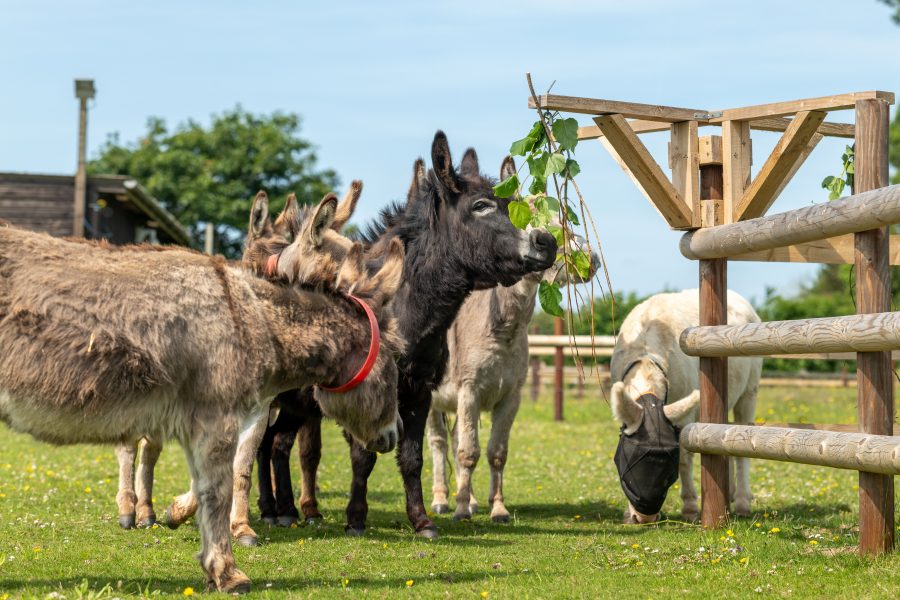
New research from The Donkey Sanctuary has revealed how the use of an evidence led, One Welfare approach to paddock design has improved the lives of a herd of rescued miniature donkeys.
The herd of miniature donkeys, which were part of the charity’s largest-ever rescue case, provided an opportunity for the charity to create a pioneering new habitat enclosure.
The researchers observed the donkeys behaviour, used video analysis and ecological surveys as well as consulted with staff to make informed decisions about how the new habitat was designed.
The grazing environment, soil health and species diversity, as well as availability of shade, shelter, and natural browsing opportunities, were also taken into consideration.
Qualitative Behaviour Assessment was used to measure the emotional state of the donkeys in relation to the placement of feeders and access to turnout areas.
Key priorities
Following the research, the below areas were identified as priorities for the habitat redesign:
- Increasing opportunities for shelter and shade.
- Creating greater privacy from public viewing when desired.
- Improving feeder placement to reduce competition and conflict.
- Enhancing environmental variation and plant species diversity.
- Providing year-round access to turnout areas.
- Supporting biodiversity and ecosystem health through improved land management.
The research supports the notion that varied and naturalistic environments which provide opportunities for choice, exploration and behavioural flexibility, benefit donkeys the most. These environments also encourage healthier ecosystems and more sustainable land management practices.
Following the donkeys’ lead
“The most rewarding part of redesigning the mini’s paddock and housing was being able to let the donkeys guide us,” said Sarah Worth, lead author and research officer at The Donkey Sanctuary.
“We could see how they used the existing space and then bring those observations together with ideas from colleagues across the sanctuary.
“The ecology team led the thinking about the land itself, bringing vital expertise to designing the space from the ground up.
“It’s been lovely to see all these perspectives come together with the shared passion for our donkeys’ welfare and well-being at the heart of it.”
The project forms part of The Donkey Sanctuary’s wider commitment to evidence-based welfare and continuous improvement of the lives of donkeys in its care.
The donkeys can be observed in their new habitat at The Donkey Sanctuary’s headquarters in Sidmouth, Devon.
Image © The Donkey Sanctuary.