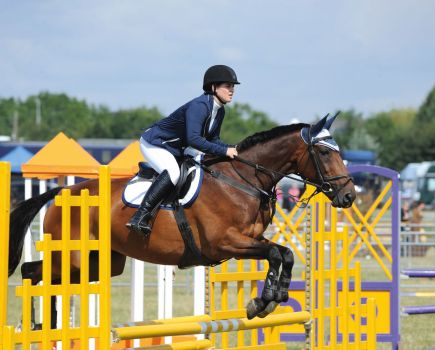

It is all too easy to accrue four or more faults for knocking down a fence during a showjumping round, potentially costing you and your horse a top placing.
With particular exercises practised at home to improve the quality of a horse’s jump and that expertise utilised in the ring, you will improve your chances of pulling off a clear round.
There are many other things that riders can do, too, to avoid careless pole knocks, which we will explain on this page.
Tack fit
Firstly, check your saddle fit. You should also make sure the horse’s bridle fits correctly and that they are wearing the right bit.
Could it be too strong, making the horse tuck their nose in too much? If their neck is short and tight they can’t use themselves properly.
If they have their nose out, they can use their body and back more effectively over a fence.
Rein contact
Think about the contact down the reins to the horse’s mouth. If they are kept on a short, tight rein, they won’t be able to softly bascule over the fence.
The rider letting out their reins — even by a fraction — will allow the horse to take the contact forward.
It is also important when jumping a course to keep a consistent rhythm, as this will give the horse the best chance of clearing all the fences.
As well as remembering to breathe, riders can count or recite the days of the week as they go around the ring.
Alternatively, they could say something to themselves, such as “Keep the rhythm”.
It doesn’t matter what it is as long as it works.
Bascule
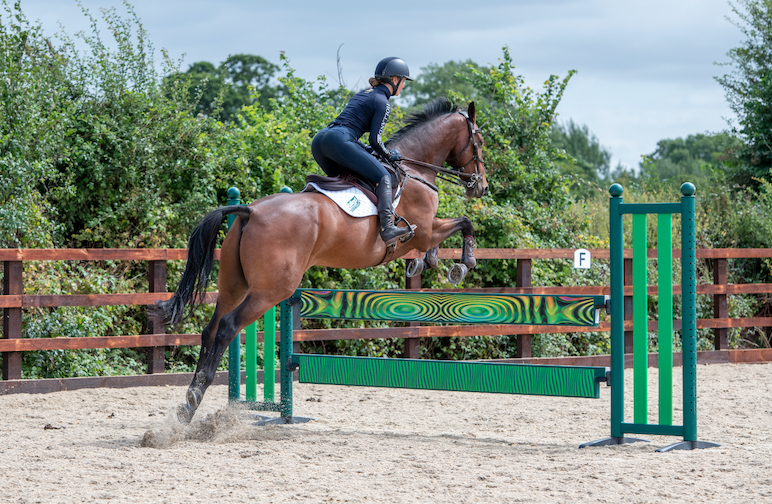
By bascule, we mean the shape the horse makes over a fence — the natural round arc of their body as they go over.
There are things you can do in training to help develop a horse’s technique.
“Try gymnastic work,” advises five-star event rider and BHSI and BE accredited trainer Helen Martin.
“Using V poles helps the horse to stay straighter and push with more power to bascule and become rounder.
“You can also use a place pole in front of the fence and a landing pole afterwards.”
Doing these things encourages the horse to keep their balance coming into the fence.
“They also prompt them to lower their head and look at the landing pole while jumping, preventing hollowing as they bring up the head,” adds Helen.
“Such poles also help the horse to use their shoulders and lift their withers as they land and to think about footwork.
“I might also use a low but wide fence to get the horse to really open their back.”

Falling out through the shoulder
When turning to a jump, you want to feel that your horse’s body is turning with you, rather than the shoulders ‘falling’ out or in, which will affect your striding and make turns trickier to ride.
In this scenario, Helen recommends using tramlines in your training.
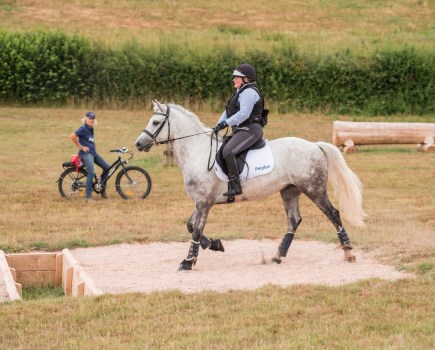
Set poles and blocks out like tramlines so that you ride through them into the jump and after landing. You can
use these tramlines on a diagonal line, too. Use them to stop the horse falling in and anticipating the turn. You can even mark out a square shape so that you do a bit of flatwork afterwards. Your inside leg is also there as an aid to move the horse away and not fall in.
If your horse doesn’t understand this on the flat, the problem will only become magnified when you jump. I
would introduce leg yield and some lateral work on the flat. Jump a fence and move into a flatwork movement, riding a square afterwards or going straight and then turning a circle. The horse has to stay upright and in balance as a consequence.
How to stay confident in your jumping position
Helen recommends using a set distance if you are struggling with your confidence in your position while jumping – or if you are just looking to improve your jumping position.
“Practise using a set distance so that you can focus on your position rather than panic about the fence,” says Helen. “Think about securing your lower leg position so that you aren’t unbalancing the horse, whether that is by getting ahead of the movement or being behind it and hollowing the horse’s back. Stay in the middle, with your weight in your heels. Eyes should always be looking through the horse’s ears, ahead and in the direction you are wanting to travel.
“If, however, you want to land and turn left, for example, if you look too much that way over the fence you can throw the horse off balance. Therefore, look straight and focus on jumping the fence straight.
“You want the horse to develop his push and power off the floor with a balanced take-off. Also think about influencing his balance and rhythm with your seat and upper body rather than your hands. Keep these level by the neck strap. Quite often I bridge the reins to keep my hands down and level.”
How to best walk a showjumping course for ultimate results
Helen recommends keeping a close eye on lines in a course while walking it, as well as using the arena.
“Look at your lines as well as using the arena. Where are you going to turn?” she says. “At a higher level, if you are looking to cut a few metres off the track so that you don’t accrue time faults, you might want to think about turning inside a fence. Or, to help guarantee a clear, stay out a little to give the horse more time to read the fence.
“Use of the arena really is key, as is making sure that you are on a line and jumping the fences square, straight and in the middle.
“Watch other rounds to see how the course is riding and, if you can, watch from different angles. You can then appreciate how distances ride for different horses and how the lines taken can affect the distances or the approach to fences.
“Turning points can be influential — they can add or take away half a stride. Walk the distances to see if they walk short or long.”
Helen also says that you should think about the topography the jumping arena.
“Consider the terrain, too. Grass arenas can be on a slope so if you are riding to a combination downhill, the horse will make up that distance, but when riding uphill you will need more power. The gradient will take away a bit of the horse’s impulsion
and stride length.”
About the trainer
Wiltshire-based Helen Martin (née Cole) is a five-star event rider and a BHSI and BE accredited trainer. She competed at Badminton Horse Trials last year and this year with Andreas, a 19-year-old Dutch-bred gelding, with whom she recorded a top 20 finish in Blenheim Palace International Horse Trials’ CCI4*-L last autumn. Helen is married to farrier Philip Martin.
Images: © Sally Newcomb/Your Horse Library