
Horses tell us a lot through their behaviour. Every flick, nuzzle or swish is part of their ongoing conversation — both with you and the environment around them.
The more we learn to ‘listen’, the stronger our bond becomes. While horses may not speak our language, with a little observation and a lot of curiosity, you’ll find that they have plenty to say…
Facial expressions
Facial expressions are the most useful tool for understanding the nuances of horse behaviour. Things to look at include:
- Ears — look at the position of their ears. Are they moving or locked? Are they tense or soft?
- Eyes — do the horse’s eyes display softness or tension? Is there a worry-wrinkle above the eye? Is their gaze looking into the distance or are they looking inwardly?
- Nostrils — are their nostrils dilated, wrinkled or relaxed?
- Muzzle — does their muzzle seem relaxed or tense? Are they yawning, fiddling with things in their mouth or is there any movement?
- Face — is there tension or a softness in their face?
“Generally, if you have a soft face, that is an indication of a fairly happy and relaxed horse. If you have tension, that is an indication that something is wrong,” says equine ethologist Renate Larssen during a World Horse Welfare webinar.
“It could be pain-related, especially when accompanied by an ‘inward’ gaze, or it can be stress and concern.”
Tail swishing
Context is an integral part of understanding horse behaviour, as the same behaviour can mean different things in different situations.
A good example of this is tail swishing. A horse swishing their tail in a field in the summer could mean they are just swatting away flies.
However, if they are swishing their tail in winter when there are no insects, this is more likely to indicate distress or pain, such as an early symptom of colic.
“It’s also important to consider personality, because different individuals will behave differently in the same situation,” says Renate.
“Some horses will be more likely to want to actively change a situation. If they’re in a situation they don’t like, they are more likely to flee or fight their way out of it, whereas other horses might be more likely to wait it out and hope it goes away.”
Biting
Horses use their mouths for more than eating dinner. They cannot speak, of course, and nor do they have hands. Instead, they use their mouths for all the things we would use our hands for.
Their are several reasons why a horse may bite, including:
Ingestive
“Horses will use their mouths for eating and that might seem straightforward, but it’s important to remember that eating is a type of biting. It’s the same behaviour, but just the context is different,” explains Renate.
Defensive
“Biting can also be defensive if they feel the need to protect themselves in some way. It can come from a place of frustration if they are struggling to achieve a desired outcome.”
Investigative
“It’s how they explore the world,” says Renate. “If a horse wants to pick something up or they want to see the texture of something or taste something, they use their mouths.”
Playful
“It can be playful. Again, they can’t play with their hands. They can only play with their mouths,” adds Renate.
Friendly and functional
“Biting can be friendly, such as giving someone scritches, and it can also be purely functional. They can bite something because they want to pick
it up or they want to pull it closer or move it somewhere,” explains Renate.
“It could also be because something is itchy on their body and they just want to scratch that itch with their mouths. Biting is a colourful behaviour which has many different functions.”
Frustration
Next time a horse bites you or something nearby, ask yourself what the behaviour could mean.
- What is the context?
- Is this normal behaviour for this horse?
“If you have a mouthy horse, biting might just be one of their preferred behaviours. If a horse that normally doesn’t bite suddenly starts, that could be an indication of a change in the behaviour pattern,” says Renate.
“That can be an expression of sudden frustration, for example. It might also be an expression of pain.”
Bucking
A horse bucking is primarily a defensive behaviour. It originated as a way that horses could get rid of a predator who had launched at their back, but it does have a range of other functions.
“Bucking can arise from frustration, and it is connected to this kind of stress release,” says Renate.
“It’s a high-energy behaviour and it basically comes from a place of stored energy in the body to show annoyance, frustration and anxiety — that kind of feeling that then has a moment of release.”
Bucking can also be pain-related.
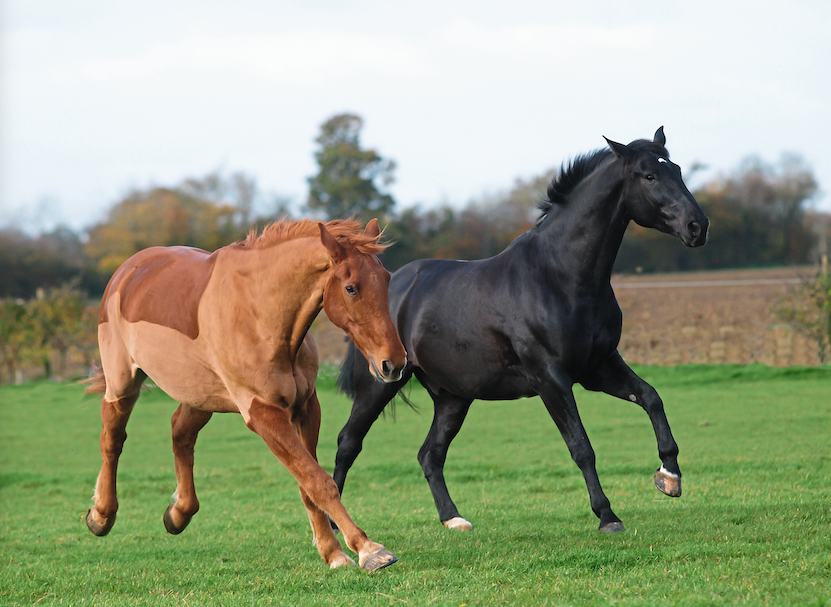
“It is sometimes called a playful behaviour, and it can be, but I really want to be cautious with that because even during locomotive, social play — such as two horses running together and one of them bucking — even in that context, it often comes when another horse is too close.
“It becomes a distance-increasing thing, which brings it back to the kind of defensive-frustration-stress triad here that we’re talking about,” reasons Renate.
“While bucking does show up in play situations, I would be cautious to describe it as purely a play behaviour.
“I think it’s more a behaviour that also sometimes happens in playful situations when the horse needs to create distance from another horse
or when it gets too rough and there’s a little bit of a stress release.”
Renate was speaking at a World Horse Welfare Wednesday Webinar, all of which are free to watch. Find out more and view all episodes here.
Main image © Shutterstock