
A horse’s environment plays a huge role in their mental and physical wellbeing. Just like people, horses thrive when their surroundings are stimulating, safe, and engaging.
Providing opportunities to explore, forage, play, and interact with other horses helps prevent boredom, reduces stress, and encourages natural behaviours that keep them healthy and happy.
Small changes — from toys and varied footing to social contact and feeding enrichment — can make a big difference in a horse’s day-to-day life.
Here are 11 things you can do to enrich a horse’s environment, as suggested by Blue Cross welfare manager Ruth Court.
Make a forage box
Make a forage box using an old cardboard box (but make sure there are no metal staples). Fill it with hay and tasty treats that your horse can rummage for, or hide sliced apple and carrot in your horse’s haynet.
“Feed herbs, like mint and parsley, or plants such as dandelions and stinging nettles, which are fragrant and tasty. They can be placed inside or outside the box,” says Ruth.
Provide a treat ball
A treat ball with small amounts of chopped up feed inside help to encourage horses to use their bodies and their brains.
Hang treats from the ceiling
“Wrap non-poisonous plants, such as willow, around the bars of the stable and hang them from the ceiling so that your horse can nibble at will,” adds Ruth.
Hide fruit and veg in the stable
“This is a great way to keep horses busy and introduce them to a variety of flavours and textures, although remember that some might be high in sugars, so may not be suitable for those on a restricted diet,” says Ruth.
Add a horse-safe mirror
Friends is one of the three Fs — there are essential basic horse care needs that we should all strive to fulfil — and fixing a horse-safe mirror to the stable can give the illusion that another horse is there.
“Many horses enjoy exploring the image of their own reflection, which can be a huge mental stimulation for them,” says Ruth.
“Horses and ponies are social animals and companionship is very important to them. Those who are kept alone have higher levels of cortisol [a hormone that is produced when stressed].”
Split up forage in the stable
Feeding from the floor is always advisable to encourage your horse to eat with their head and neck stretched down, mimicking how they would naturally eat in the wild.
“Make it interesting by splitting hay into several piles, so that the horse moves between them in his stable,” advises Ruth. “Or put some in a net and some on the floor, so that he has a choice.”
For good doers on a limited ration, try placing it in several small-holed nets around the stable to slow their eating.
Doing this will satisfy their instinct to graze and chew, and will also help to maintain a healthy digestive system. (Bear in mind that wild horses and ponies graze for between 14 and 18 hours a day!)
Spread out forage in the field
During winter, when grass is sparse, spread out your horse’s forage in piles around the field to encourage horses to move about. It will make hay last longer and reduce the number of poached areas in the field.
Aim for at least one extra pile for the number of horses you have, to ensure no horse goes without and to help avoid any arguments.
Add a branch or two
“Place branches from non-poisonous trees such as birch or willow in the field or turnout area so your horse can chew the bark and use them to scratch on,” suggests Ruth.
“Putting something new in a turnout area can often spark curiosity and gives your horse the chance to explore something new.”
Encourage scratching
“An old brush or broom head safely and securely tied in the stable or field, or a scratching mat, can help horses to relieve any unreachable itches,” says Ruth.
“They also help reduce stress — most horses love a good scratch!
Spend time grooming
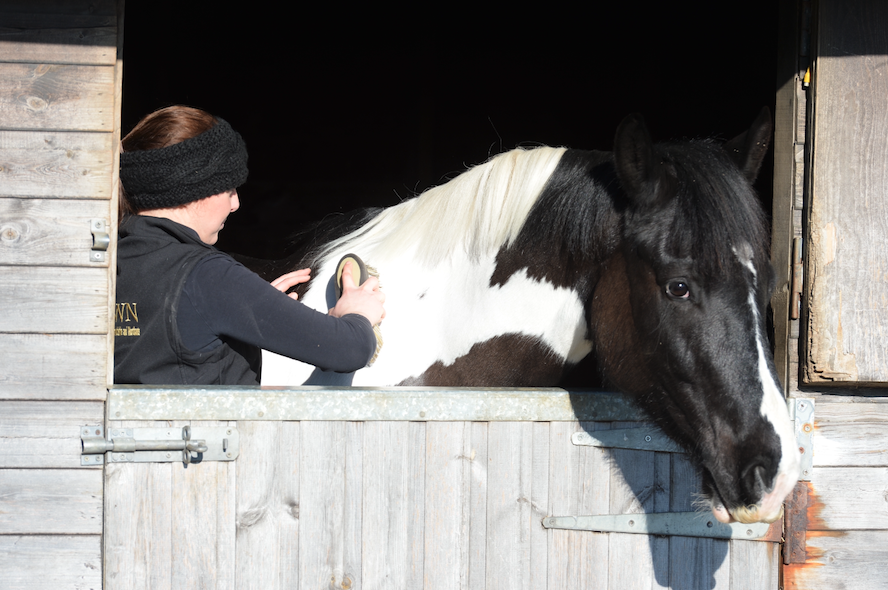
Grooming is important for health and bonding, and helps to satisfy one of your horse’s natural needs.
“Test out your different grooming brushes and see which he likes best. Find the spots that gets his top lip curling — this helps to build your bond and releases feel good hormones for you both,” adds Ruth.
Play music
“Playing music or reading to your horse can provide interesting new sounds for them, and is an opportunity for companionship and bonding,” says Ruth.
“Studies have shown that classical music can even lower horses’ heart rates.”
About the expert
Ruth Court is Horse Welfare Manager at Blue Cross. She has a BSc (Hons) degree in equine management and holds the BHSII. Ruth is also a director of the National Equine Welfare Council.
Main image © Your Horse Library/Kelsey Media Ltd