
Sponsored content in association with Dengie
You’ve identified that your fat horse needs to lose weight and are ready to act, but what are the fundamental things you can do to ensure their weight loss plan is a success?
Below are 10 top tips to help you manage your horse’s weight loss, so that they become the fittest, healthiest version of themselves.
1 Work with an equine nutritionist or feed adviser
They can help with practical advice for your horse’s weight loss plan, including advice on what and how much forage to feed and how to keep your horse’s diet balanced with the nutrients that they need without the energy or calories they don’t.
Check out the BETA Equine Nutritionist and Feed Adviser Register to find a suitably qualified expert (ENFAR).
2 Manage grass intake
Grazing often represents the greatest source of energy intake in the leisure horse’s diet and unrestricted grass intake is often the biggest barrier to weight loss.
However, managing grass intake can often be the trickiest part of a horse’s weight loss plan, especially if you don’t own your own land and have less choice regarding the paddock or herd your horse is kept with.
The key here is to look at the available options for grazing restriction to identify which is the most practical option for your situation and which is going to be well tolerated by your horse.
If, for example, you have no choice about which paddock your horse goes in to and are not allowed to implement strip grazing, then the use of a grazing muzzle is a great option. Watch this video about out how to use a grazing muzzle appropriately.
3 Make sure you meet minimum forage requirements
If your horse has reduced grass access, then the reliance on conserved forages increases to maintain their forage intake. At a minimum, all horses should consume 1.5% of their bodyweight on a dry matter basis daily.
For a 600kg horse, this equates to 9kg dry matter ((1.5/100). If you are feeding hay and assuming the hay is 85% dry matter, this equates to a minimum of 10.6kg on an as fed basis (9/ (85/100)).
4 Maximise forage intake
Whilst minimum forage recommendations exist, the horse has evolved to eat on a little and often basis, which is a behaviour known as trickle feeding.
As such, where possible we want to maximise forage intake so that we aim to satisfy a horse’s appetite. Additionally, this supports their behaviour and therefore welfare.
This can only be achieved without exacerbating weight gain if we choose the lowest energy forage source available for our horse’s weight loss plan.
The amount of energy provided by forage is influenced by its digestibility, which in turn is influenced by the type of plant, environmental conditions during growth and particularly by the age of the plant at the time it is harvested.
Hay or haylage?
Haylage tends to be cut when the plant is less botanically mature and is therefore more digestible, providing the horse with more energy or calories than hay, which is typically cut when the plant is more mature.
Hay can also be soaked to reduce its water soluble carbohydrate or sugar content which can further reduce the amount of energy supplied.

Straw
Straw is the least digestible forage source available and can therefore be a useful addition to the diet of those on a weight loss plan.
There are a couple of caveats to feeding straw. Firstly, your horse must have good teeth and secondly it must be introduced very gradually to the diet to allow time for the digestive system to adapt.
Once gradually introduced to the diet, straw can replace up to half of your horse’s daily forage intake as a lower calorie alternative. If straw is difficult to source, low calorie short-chopped fibre feeds that are predominantly straw based can be used as an alternative.
5 Make forage last longer
When forage quantities are restricted to encourage weight loss, then additional measures must be taken to extend forage eating time.
Divide the forage ration up into as many smaller presentations as possible through the day so your horse doesn’t spend significant periods of time without anything to eat.
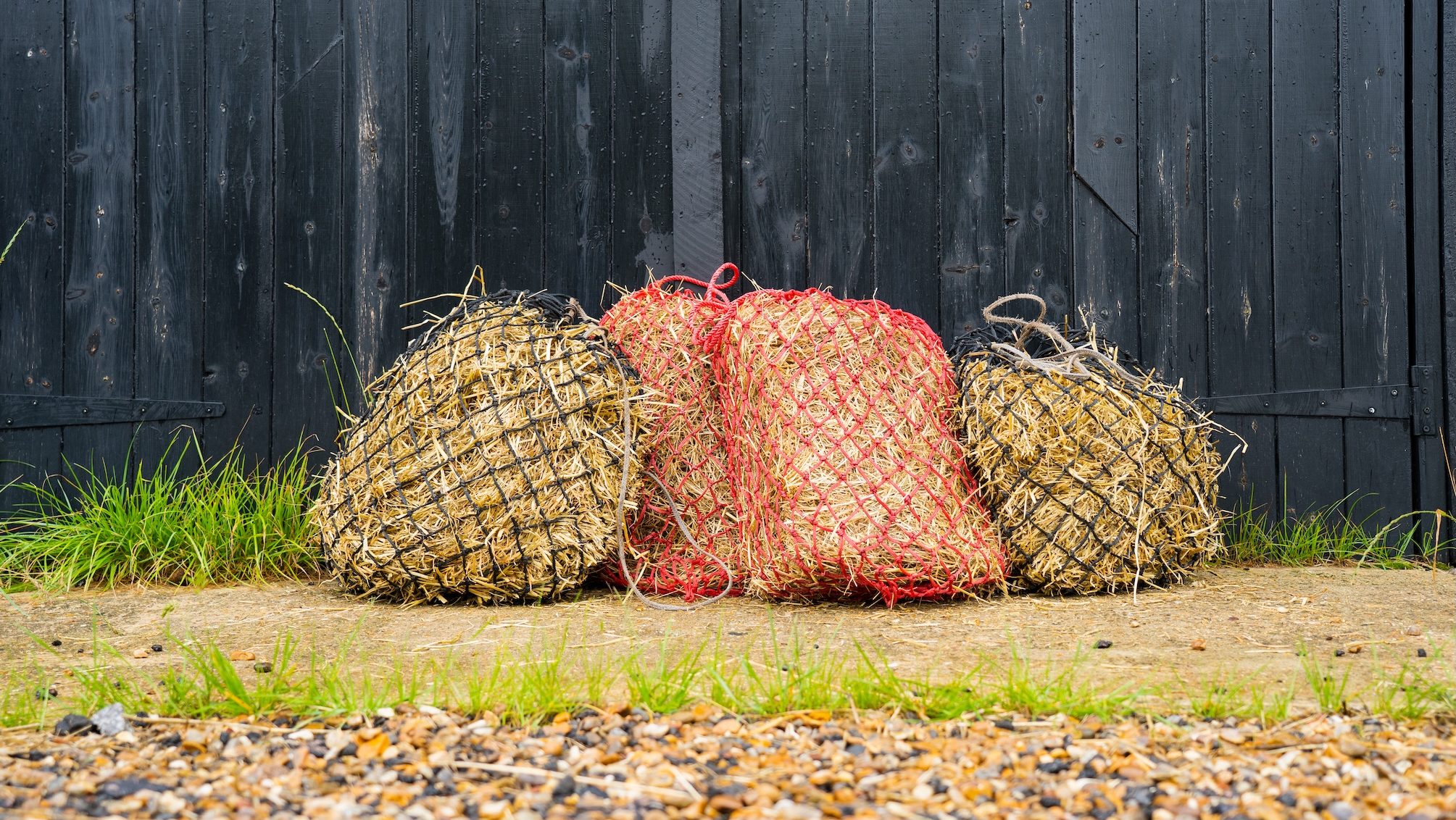
Small-holed hay nets make it more challenging to take big mouthfuls of forage, thereby extending eating time. Divide the hay ration between multiple, loosely filled nets in the stable to encourage foraging behaviour and to slow the rate of intake.
Mixing straw through the net of hay or haylage not only helps to reduce the energy intake but increases eating time as the horse spends more time sorting their forage.
6 Maintain nutrient intake whilst decreasing energy intake
Restricted grazing, soaked and/or restricted hay and increased straw use can all result in a reduction of nutrient intake, particularly vitamins, minerals, and quality protein like the essential amino acid lysine.
This is the main reason for still providing the horse with a bucket feed to top up on nutrients that are lacking in the diet while on a weight loss plan.
This can easily be done by combining a low-calorie chopped fibre feed for chew time with a feed balancer at the manufacturer’s recommended daily feeding rate.
Make sure the balancer is suitable for your horse’s workload and, if your horse’s diet is very restricted or uses a lot of straw, they may require more than the minimum feeding rate of the balancer, or one that is a higher specification. Seek advice from the manufacturer.
6 Tempting treats
Whilst we all love to provide our horse with tasty treats, remember that every calorie counts and treats should be used in moderation.
Provide enrichment by using things that promote extended eating time ,such as treats hidden amongst forage or by using forage or hay balls.
Horse-safe veggies are low calorie options for stretching or clicker training treats.
7 Keep monitoring
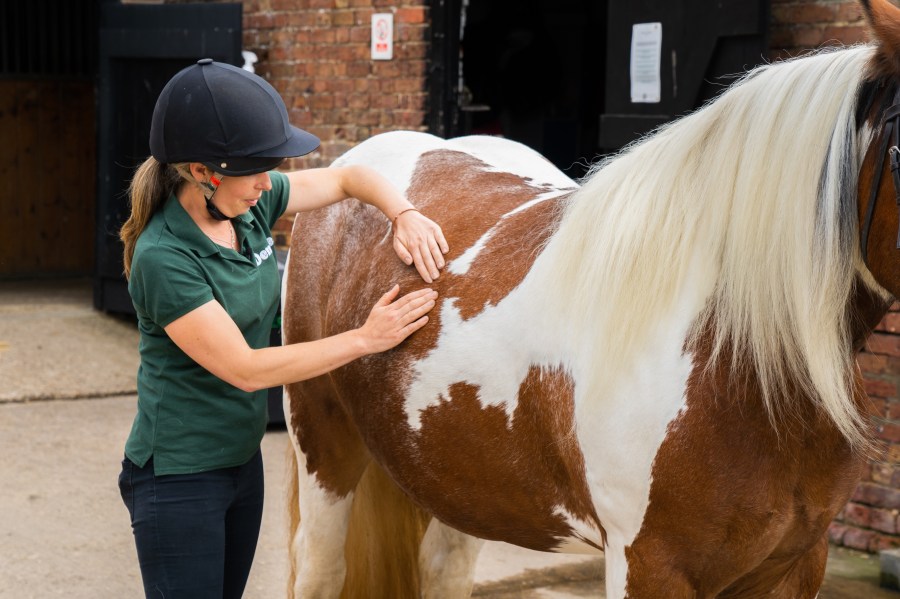
We don’t just mean your horse’s weight, although we recommend this is done fortnightly with a weigh tape and by monthly body fat scoring.
You should also regularly weigh your horse’s forage (and if any is left over that as well) to monitor intake and ensure they are eating enough.
Count the number of droppings too and keep an eye on water intake, as these measures are important for monitoring health.
8 Buddy up
If anyone else on your yard has a horse on a weight loss plan it can be very helpful to buddy up. Not only will this help with motivation, but you may be able to help each other out with things like different feeding times.
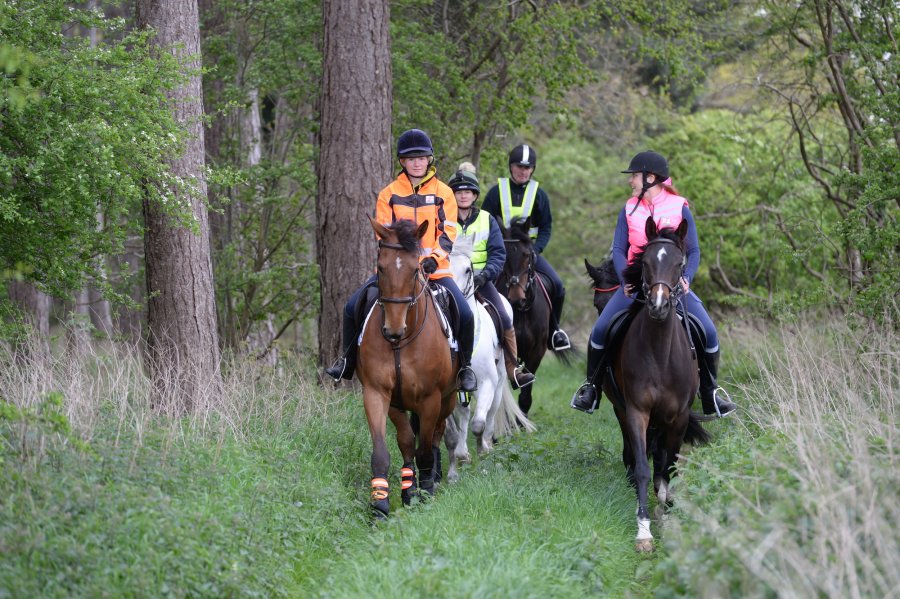
If your horses are in ridden work, it can also make calorie-burning exercise more fun by doing it together.
9 Welfare in other ways
We’ve talked a lot about forage, but beyond forage don’t forget that friends and freedom (choice) are also important to your horse as well.
Whilst encouraging weight loss, there are still ways that you can give your horse a choice, such as different forages in different nets and locations (cafeteria diet), plus nets of mixed forages to encourage foraging behaviour.
When planning grazing restriction methods, also consider ways to try and maintain your horse’s turnout with their friends as well.
For advice on a horse weight loss plan contact Dengie