
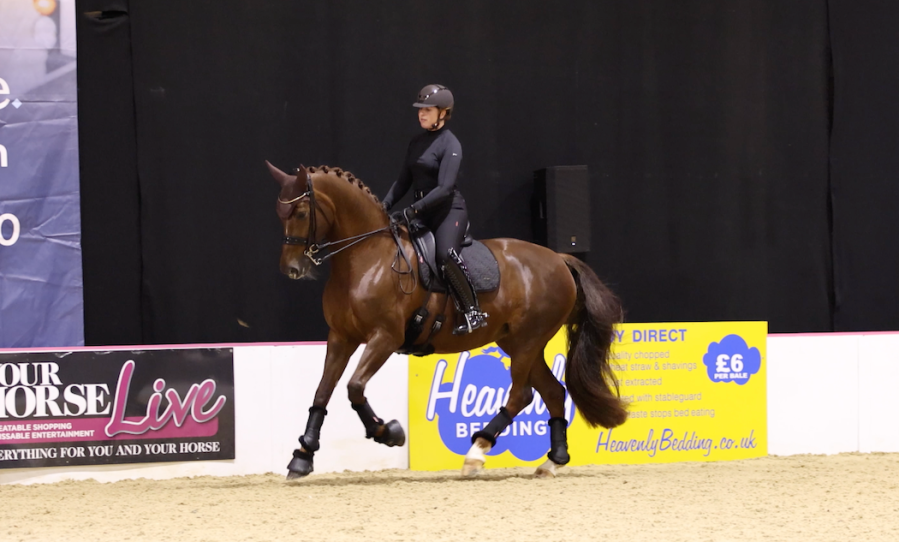
Olympic dressage rider Becky Moody treated fans to fantastic insight into her calm, methodical, and highly informative training techniques at Your Horse Live in 2025. She opened the weekend’s demonstrations with what she describes as a “whistle stop tour of dressage” — and you can watch the main highlights below.
During the session, Becky rode eight-year-old mare Magic Dream (affectionately known as ‘Shroom’ at home), while her stable rider, Anna Burns, worked with the four-year-old gelding, Raver.
Becky explained that both she and Anna have been working with Raver since April 2025 and have already enjoyed success in both young horse and prelim-level classes.
Magic Dream, meanwhile, has been produced by Becky since she was five and has progressed successfully through the levels, winning the prestigious Future Elite Championship at the Horse of the Year Show (HOYS) in October 2025.
The walk
Becky begins assessing the paces by describing what she looks for in a good walk.
She emphasises that the most important element is the correctness of the rhythm – a clear, consistent four-beats.
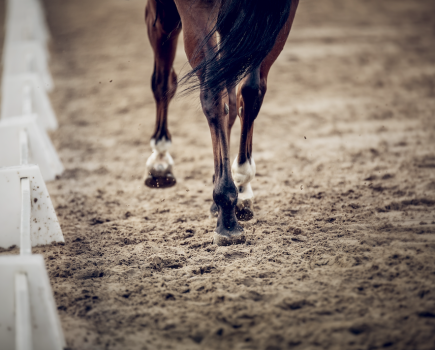
She also highlights the importance of a good overtrack: “If you look where the front foot leaves an imprint in the sand, the hind foot should land clearly over and in front of that mark,” she explains.
Becky explains how to assess the “triangle” in the walk too: “If you look at the front and hind legs on one side of the horse, when the front leg is back and the hind leg is forward, you can see a triangle – the legs and the horse’s tummy form the three sides.”
She observes that Shroom naturally carries a little more tension than Raver and therefore doesn’t show quite the same looseness and degree of overtrack.
The trot
Moving on to the trot, Becky again emphasises the importance of rhythm – the clear, regular two-beat – along with suppleness.
She explains that there are two types of suppleness to consider; lateral and longitudinal.
“Lateral suppleness is the one you all think about straight away – left and right bend,” Becky says. “Longitudinal suppleness is that front-to-back adjustability.”
When Raver trots, Becky notes, he already looks naturally easy and relaxed, with visible softness through his back.
She explains that, at the moment, Raver is a little too round in his frame, and because he is only four years old, his poll sits slightly low.
As he gains confidence and strength, they will gradually encourage him to work in a more uphill, competition-ready outline.
The canter
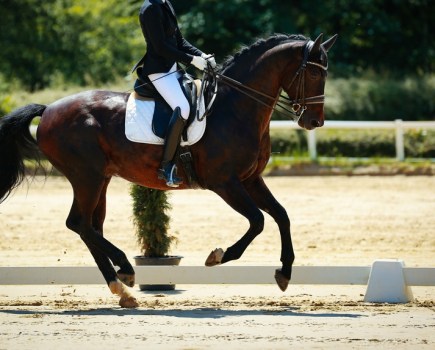
In the canter, Becky focuses on rhythm – the clear three-beat sequence of outside hind, then the inside hind and outside fore together as a diagonal pair, followed by the inside foreleg. She emphasises the importance of being able to adjust the rhythm.
Anna demonstrates this by riding Raver forwards and back to show his adjustability, taking him forward along the long side, before rebalancing him on the short side.
Adjustability
“If you say go, do they go? And when you say whoa, do they whoa?” Becky explains that this principle is a fundamental building block of training.
She adds that when riding at home, she rarely stays in the same trot or canter for any given time.
Becky encourages riders to examine the finer points of their horse’s training:
“How much can you adjust your horse’s rhythm, your horse’s bend, the contact, the compression, the frame? Very often, the answer is that we can’t adjust them enough.”
Transitions, transitions, transitions
“Whether they are within the pace or between the paces, transitions are one of your most fundamental building blocks.”
Becky asks Anna to demonstrate an exercise in which she trots a square, making walk transitions at each corner. She explains that corners are, for her, the most important part of every dressage test:
“Why? Because this is where you set up what’s coming, and it’s where the judge has the worst view of you – hence the best place to make corrections. Use your corners to set up and show off.”
Becky acknowledges that there have been challenges in Shroom’s training that she has had to work through carefully.
She explains that she has focused on adding more “spring” into Shroom’s canter. To illustrate, Becky demonstrates how she developed the self-carriage by riding transitions within the pace.
Becky explains that a common mistake riders make is equating collection with slowing down.
Instead, she emphasises the importance of maintaining a slightly quicker tempo within the collected frame.
“What I want to feel is the horse holding herself, so that she is on my seat.”
Becky elaborates on what she means by being “on her seat”.
“It’s about engaging your core. I’m not pushing down with my seat, because I don’t want to push the horse’s back away from me.
“Instead, I engage my core by tucking in my abdominal muscles and keeping my lower leg underneath me.
“This allows me to maintain the activity and support the horse effectively.”
‘A little bit sideways’
“I say to people that I spend about 85% of my time going a little bit sideways.
“Most of my work is spent in shoulder-fore, especially on the left rein,” Becky explains.
She says that most horse and rider combinations tend to curl to the left and do not show enough bend to the right.
To correct this, Becky uses shoulder-fore on the left rein, incorporating transitions while maintaining the shoulder-fore positioning.
Once she feels the alignment is correct, she begins asking for travers (quarters-in) to start developing the horse’s gymnastic suppleness.
‘Head on the boards’
Becky used Anna and Raver to demonstrate one of her favourite exercises, which she termed “head on the boards”.
She explains that once a horse has grasped the idea of leg-yielding from an inner to an outer track, she then asks them to leg-yield along the wall, with flexion to the outside and quarters-in.
“I really love this because it helps maintain consistency, having the wall in front of them.
“It keeps things organised and allows the rider to manage the angle more effectively. It’s also more closely linked to the shoulder-in positioning.”
Flying changes
Becky then works with Shroom, riding some tempi-changes along a diagonal line.
“She was quite sensitive to the [leg] aid there, so I’m going to do some changes on a circle.
“The funny thing is, to get changes really straight, you have to have the horse straighter on a circle than you do on a straight line.”
Becky explains that this is an exercise she uses frequently, noting that Shroom began to relax more during the changes as a result.