
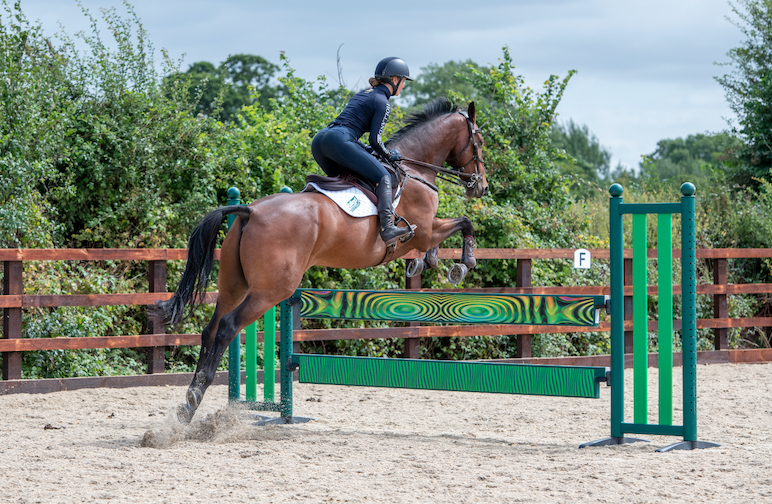
Do you ever find yourself feeling unsure on the approach to a fence — and that perfect take-off spot tricky to find? It’s a common problem, but we have good news — it can be fixed.
The way to avoid panicking is to plan ahead. You need to be set up with the right canter and a clear decision about your route to the fence — and beyond — before you turn the corner and approach.
Commit to the fence
According to Will Fletcher, who is the eldest son of showjumping legends Tina and Graham Fletcher and who has made several senior Nations Cups appearances, committing to the fence and riding proactively is key.
It’s much better to make a decision and commit, because most of the time it’ll come out well.
“Even if the horse doesn’t end up meeting the fence perfectly, riding with purpose is much better than getting in a muddle and backing off,” he explains. “You can’t fix a poor approach in the last couple of strides.”
Relax
“I often see horses get strong when the rider is a little bit tense and is holding the contact too much,” says Will.
“Again, planning is key. It’s harder to feel nervous if you know what’s coming. Then, as you come around the corner, take a deep breath and relax your shoulders, elbows and hands to help remove some of that tension.”
Leg to hand connection
“Another thing to consider is your leg to hand connection,” adds Will. “If you forget about your leg and just pull, the horse will go against the contact.
“If you keep a little bit of leg on and hold the contact in a soft way — with relaxed shoulders and hands — you won’t get stuck in a battle of wills, because this will ask your horse to maintain the power but shorten his stride.
“In this way the horse stays with you rather than running against your hand.”
Confidence in the canter
Some riders lose confidence on the approach to a fence, which affects the quality of the canter and the take-off point.
“Work on keeping a bigger canter around the corner and on the approach,” advises Will. “When a rider doesn’t trust their eye it makes them cautious and they come to the fence a bit slow, then a few strides out they over-push to make up for the loss of power.
“Approaching in a slower canter means that you don’t have enough energy in the gait to adjust it.
“If you start in a bigger canter in a regular rhythm you then have the option to either contain or push, which makes the approach much smoother.”
Seeing a stride
For riders lacking confidence in their ability to see a good stride, Will recommends training their over poles.
“Sometimes it’s the pressure of having to jump a fence that puts riders off,” he says. “My advice is to forget jumping and work over poles instead.
“Once you can keep a good quality canter to a pole and meet it on the right stride, it’s really no different when the poles become fences. The distances and pace all remain the same — all that changes is your position over what is now a jump.”
Place poles at random
You don’t need to set up the poles in any kind of formation — randomly on the ground around the arena or field is fine.
“Riding planned routes over them with the aim of keeping a strong, forward canter rhythm and playing with lengthening and shortening the stride will soon have you meeting poles on the right stride every time,” says Will.
“Once you can do this, you’ll have a quality, adjustable canter to use over fences and the knowledge that you can find a stride.”
Keep it clean
When a horse chips in a half-stride in front of a fence, it is usually down to rider error, states Will, and the solution is polework every time.
“The random pole exercise [above] will assist and repetition is key,” he says. “This really helps you to analyse where you went wrong and to make adjustments to your riding.
“Canter poles before a fence are always good, but it’s best to wait for your trainer to help and oversee you so you know that they are set up correctly.
“Really, though, you can put poles anywhere in any sized arena and practise all the skills you need.”
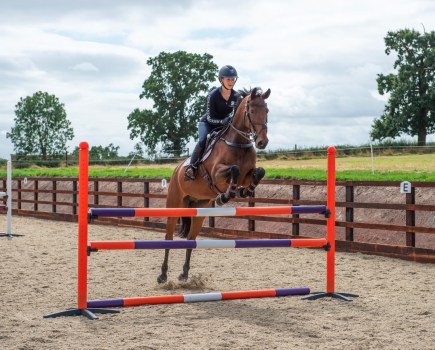
Main image by Sally Newcomb © Your Horse Library. NB This is a stock image and Will Fletcher is not pictured riding.
Related content
- FEI coach explains how to stop a horse chipping in a stride when jumping
- Will Fletcher’s exercises to improve the quality of your horse’s strides when jumping
- Jump out of trot to test rider balance and build trust with this exercise from Piggy March
- Joe Stockdale’s exercises to stop a horse drifting between fences