
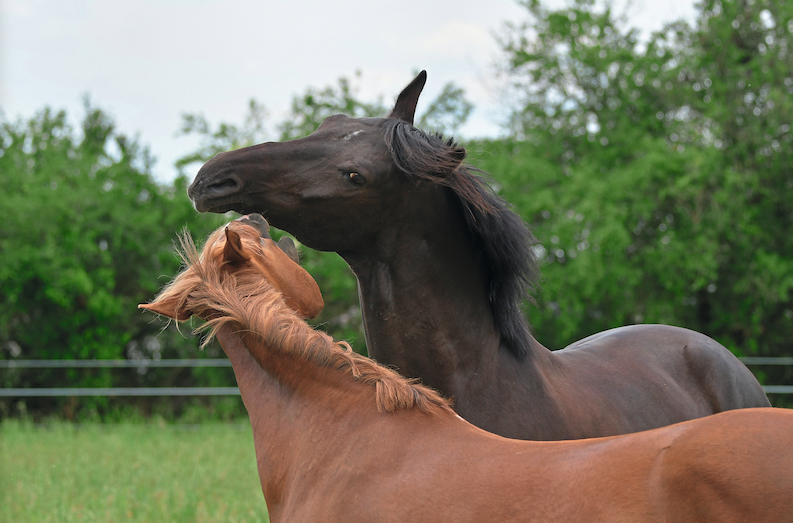
Behaviour is anything and everything a horse does for any reason and at any time. Any moment the horse exists in the world, that horse is behaving in some way, even if they are standing still or sleeping.
All behaviour, including every expression and any sound they make, reveals a horse’s feelings, motivations and priorities. With a little practice, you can learn to ‘listen’ with your eyes — and maybe even anticipate what your horse will do next.
In simple terms, the way that behaviour works is that a horse will experience some kind of situation or an event. The horse perceives that situation through its senses — vision, hearing, smell and touch — and that perception then goes to the brain.
The perception undergoes an appraisal stage in the brain, then a decision is made on how the horse should act and an action follows. That action is the behaviour that the horse’s owner or rider sees.
“All behaviour has some type of underlying emotion that drives it,” says equine ethologist Renate Larssen during a World Horse Welfare webinar.
“The reason it’s so important for us to be able to understand our horse’s behaviour is because we want to be safe around them. We all know that some behaviour can become dangerous for us, whether that’s kicking, biting, rearing or bolting.
“Also, we want to have good relationships with them and, ultimately, relationships are about communication.”
Lens of communication
Horses are the original social network. In the wild, they often live in small, cohesive groups that share land with several other groups. They all interact and interrelate with each other.
“Horses have the capacity to negotiate complex social environments and this level of social complexity requires a nuanced vocabulary. Horses have a really complex body language and facial expressions — a nuanced vocabulary to navigate all these different social situations — and that vocabulary is body language,” explains Renate.
When we view horse behaviour through this lens of communication, it serves a number of purposes:
- Maintains social cohesion in the group.
- Prevents and solves conflicts.
- Protects limited resources.
- Transmits information between individuals.
“The way horses do this is through body language, facial expressions, sounds and smells,” adds Renate.
All behaviour carries meaning
People don’t have sophisticated enough noses to detect the scents that horses may communicate with, so we need to rely on their body language, facial expressions and sounds they use.
“It’s important in this context to remember that communication is a two-way street that goes between us and our horses. So, their behaviour, when it is intended as communication to us, we’re supposed to respond to that. We’re not just supposed to passively observe,” adds Renate.
“Looking at some key principles of interpreting behaviour, number one, all behaviour has meaning, always.
“Even if the behaviour isn’t intended as communication, even if the horse is doing something that isn’t meant for our benefit, isn’t meant to convey any information to us or to somebody else in their vicinity, it still carries meaning about how they feel,” continues Renate.
“It tells us about the emotion that is underlying the behaviour. It tells us about their motivations in that moment and it tells us about their priorities as well, because they can have many competing motivations at the same time, and sometimes they have to choose between them.
“All behaviour always carries meaning, even if we might not, at first glance, understand it.”
How to interpret horse behaviour
There are three key things to look for:
1 Approach or avoidance
“First, we want to look for whether they are approaching or avoiding something. That can tell us if they like something or someone, or if they dislike something or someone,” explains Renate.
2 Energy levels
“We can also look at the horse’s energy levels: is it a high-energy behaviour or is it a low-energy behaviour? This gives us information about what the meaning might be and what the emotional intensity might be.”
3 Facial expressions
Renate explains that we should pay attention to a horse’s facial expressions as well, because behaviour is ambiguous and complex.
“Facial expressions can often be a clue to the underlying emotions, and that’s where we will find the most nuance in many cases,” she says.
Renate was speaking at a World Horse Welfare Wednesday Webinar, all of which are free to watch. Find out more and view all episodes here.
Main image © Shutterstock