
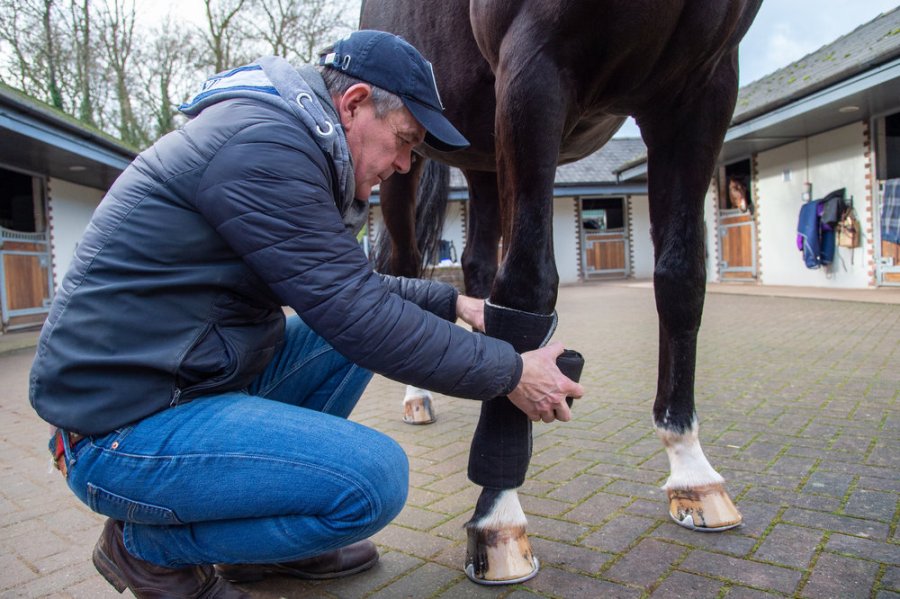
The main function of stable bandages is to provide protection, support and warmth to a horse’s tendons and ligaments. They can also be used to help with horses whose legs ‘fill up’ (edema), and to cover the leg after applying a wound dressing, poultice or topical application, such as a cream.
However, it’s often said that applying a stable bandage incorrectly is worse than not applying one at all. We asked supergroom Alan Davies how to apply the perfect stable bandage. This is his guide:
Step 1
Place the starting edge of the bandage at the inside front of the cannon bone and unroll it around the leg, ensuring as you go that the fabric and padding underneath remains smooth, flat and wrinkle-free.
Step 2
Wrap the bandage around the leg once to keep the end in place.
Step 3
Continue to wrap the bandage down the leg in a spiral pattern, overlaying the previous wrap of bandage by half.
Step 4
Try to maintain consistent tension on the bandage as you wrap and keep checking that the layers underneath are smooth and flat. If you feel any bumps or wrinkles, start again, as these are a risk of pressure sores.
Step 5
Ideally, end the bandage at the outside front of the leg, just below the knee or hock. Leave an inch of the gamgee/padding showing above and below the bandage, and fasten the Velcro.
Feel over and around the bandage for any lumps, ensuring it is smooth and flat all over.
Pressure check
Insert two fingers under the padding behind the knee to make sure there isn’t any pressure on the joint.
Top tips
- Ensure legs are clean and dry to prevent rubbing and sores developing.
- Apply the correct tension. The bandage should be tight enough to stay in place, but not so tight as to restrict blood flow.
- Wrap bandages from front to back, outside to inside (counter-clockwise on left legs, clockwise on right). This ensures tension from the bandage is applied to the front of the leg, rather than the delicate tendons at the back of the leg.
- Always wrap legs in pairs, such as both front legs or both hindlegs.
- Always use a padding, such as gamgee, underneath stable bandages. They should never be applied directly to the leg.
Main image by Sally Newcomb. © Your Horse Library
Related content
- How to poultice a hoof: Alan Davies’ step-by-step picture guide
- 5 things your horse’s vet really wishes you wouldn’t do
- ‘Their memories are etched in my heart forever’: groom Alan Davies’ tribute to Valegro and Uthopia
- How to make your horse’s coat gleam: supergroom Alan Davies shares his daily grooming routine