
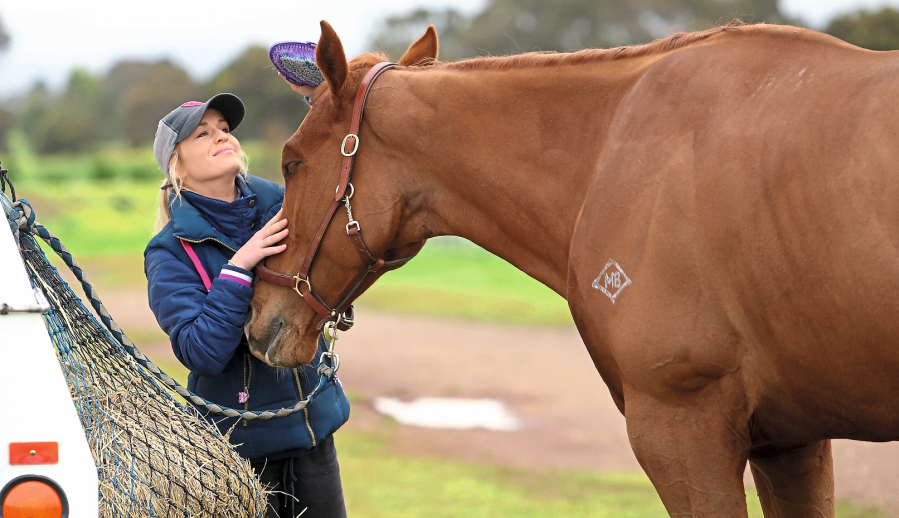
From Arctic Soul, who evented at five-star level with Gemma Stevens, to Barbers Shop, shown successfully by Katie Jerram-Hunnable — many ex-racehorses have gone on to flourish in second careers.
These horses can be exceptional partners for any rider, providing you’re prepared for their Thoroughbred energy, brain and boldness. Celebrated for their trainability, athleticism and intelligence, a former racehorse’s early training fosters focus, responsiveness and mental toughness.
For some riders, this makes them an ideal riding partner — but it can also be exactly why they aren’t suited to everyone.
Accustomed to routine, structure, confident handling and high-pressure situations, these horses are both brave and sensitive.
With the right retraining and care, former racehorses can make loyal, versatile and rewarding riding partners — proof that life beyond the track can be just as exciting as a day at the races.
Difficult or misunderstood?
Kevin and Pam Atkinson, who founded the ex-racehorse charity New Beginnings 15 years ago, say that in their experience, so-called “difficult” behaviour is rarely the horse’s fault, but often a result of a lack of understanding about life beyond the track.
When an ex-racehorse first arrives at the yard in East Yorkshire, their first task is simply to adjust to life after racing.
“Depending on the time of year, they get three to six months just to be a horse,” says Pam. “They take a deep breath, then you get a horse that is relaxed and ready to start learning in a different way.”
The amount of downtime each horse needs can vary.
Pam explains: “Some need longer than others. Some are so laid-back that they are practically horizontal from day one. The key is not to rush the process at the beginning; if you take the time, you have a good chance of making it work.”
Retraining manager Beth Coupland adds that although ex-racers can be affordable to buy, people need to think about the horse’s requirements before committing.
“They need time. I think a lot of people buy them because they are cheap, but they haven’t got the back-up to retrain them. Thoroughbreds are intelligent horses and you need to be a step ahead of them.”
Instinctive behaviour
It’s not just the retraining under saddle that takes time and careful management — adjusting to a new routine and way of living outside of a professional racing yard can be equally demanding.
Turnout, for example, requires diligent planning. At New Beginnings, small paddocks are used initially to help the horses acclimatise.
“Sometimes we will introduce a companion into the small paddock, but we are careful about who we select to put them with,” explains Pam. “The horses are very adaptable, but it’s just about doing it in steps.”
Even simple tasks, such as standing at a mounting block, require patience, because jockeys often vault on as the horse walks past.
“One of the issues is that they don’t understand how to stand still at a mounting block [because they’ve never had to], so we spend a lot of time letting them stand and associate the mounting block with something that’s nice. The process is similar to backing a new horse,” explains Beth.
Suitability
Thoroughbreds need the right approach and this is why they are not suitable for every rider, especially those lacking experience.
“There are people taking on ex-racehorses now that shouldn’t be,” confirms Pam.
“It’s like the difference between having a Fiesta or a Ferrari. If you can’t drive a Ferrari, it’s going to scare you, which is a bit like riding a Thoroughbred without respecting it. They have a brain and will get you out of trouble most of the time.”
It’s this rare combination of intelligence, courage and adaptability that can make ex-racehorses such extraordinary partners, but as they are former high-performance athletes, many require regular, consistent work — even in a hacking home.
Main image © Shutterstock