

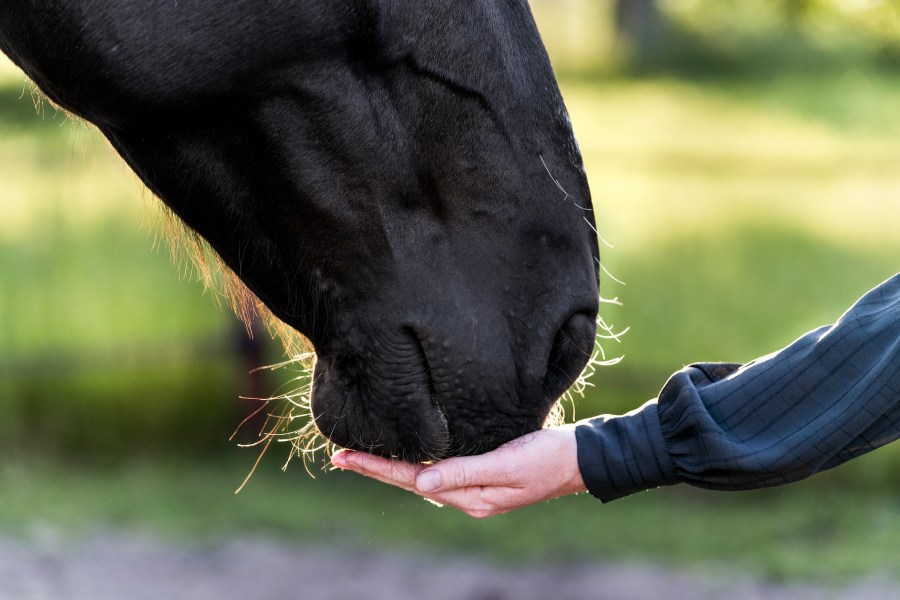
Seasoned equestrians may feel confident they know how to take care of a horse, but do they understand the impact their emotions can have on their four-legged friends? New research has found subtle changes to our scent can impact the behaviour of our horses, even if our verbal and physical cues remain the same.
The French study, recently published in the scientific journal PLOS One and involving 43 Welsh mares, found that equines were more afraid and less likely to approach handlers when exposed to the smell of human ‘fear’ sweat.
Thirty human participants watched either a horror film (the fear context) or a lighthearted clip (the joy context) while their sweat was collected using cotton pads under their armpits. The scent-infused pads were attached to nylon muzzles which allowed the team to monitor the horses’ behaviour when presented with different odours.
When exposed to the odour from the fear context, horses touched their handler less, gazed more at a novel object and were more startled when an umbrella was suddenly put up, compared to horses exposed to odours from the joy context or control odour.
“These behaviours indicate higher fear responses and less willingness to interact with humans when exposed to fear-related odours,” the team, led by Plotine Jardat, explained.
“More than just a reaction to odours, there appears to be an analogy between the emotional state of the [human] and [the horse]. The observed responses indicate a shift towards a more negative and higher arousal emotional state in horses, consistent with the emotional valence and arousal of the human emitters.”
The team’s observations suggest that ’emotional contagion’ of fear through odours could occur interspecifically, but noted that these results need validation from independent studies.
“The reactions observed in horses could be spontaneous […] or they could result from associations formed by horses between some odours and the situations in which they are usually present, for example, horses could have associated odours emitted by fearful humans to stressful contexts,” they said.
“The fact that different species appear to respond to each other’s emotional chemosignals is interesting, as emotions have previously been viewed as mainly internal states that serve to regulate individual behaviours and produce signals that inform conspecifics of danger or resources.
“Fear derives from the perception of danger, and is probably the most widely shared emotion in the animal kingdom. Its function is to trigger a fight-or-flight response, so emotional contagion of fear could be adaptive for animals to warn each other of danger, even when it involves different species.”
Library image by Shutterstock